
Key Takeaways
- The State Department’s 2026 Investment Climate Statement for Kazakhstan puts the FDI stock at about $170 billion as of January 1, 2026, including $35.5 billion from the United States.
- It flags increasing regulation, localization and import-substitution policies, and corruption, while investors seek stronger rule of law and predictable tax rules.
- Kazakhstan’s new Tax Code, effective January 2026, raised the standard VAT rate from 12% to 16% and introduced sector-based corporate income tax rates.
- The report suggests US investment in hydrocarbons may be higher than official figures show because some capital is routed through third countries.
How Much Have US Companies Invested in Kazakhstan?
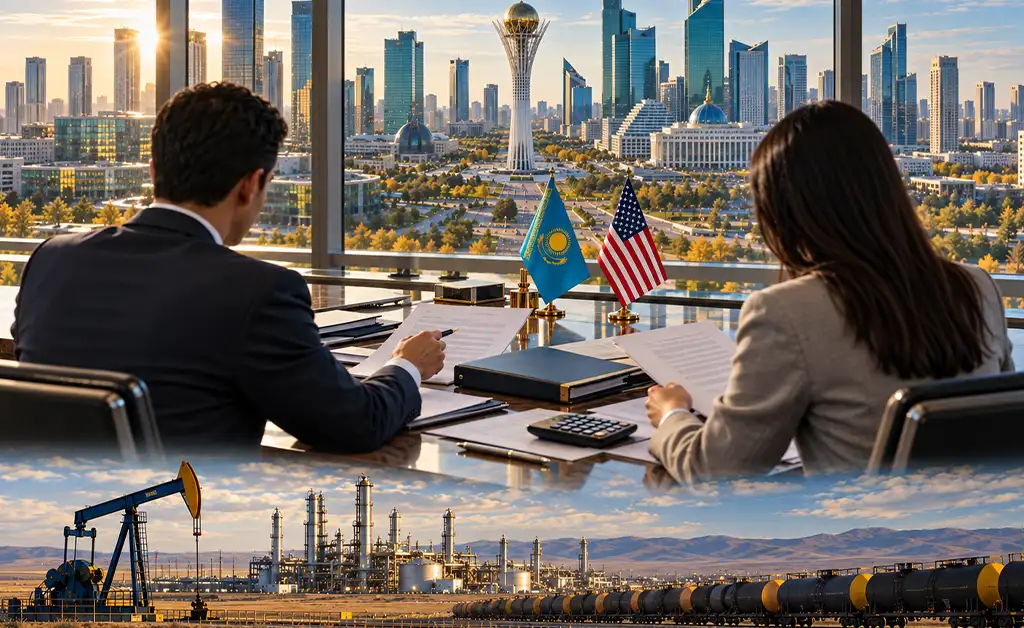
The State Department’s 2026 Kazakhstan Investment Climate Statement records American investment of approximately $35.5 billion within a total foreign direct investment stock of around $170 billion.
In This Article
That places the United States among the most significant foreign investors in the country — a position built largely through decades of energy sector participation, and one that gives American firms considerably more at stake than the current volume of bilateral trade alone would suggest.
It also means the risks the statement identifies are not hypothetical. They apply to capital already deployed.
What Risks Does the 2026 Kazakhstan Investment Climate Statement Flag?
The assessment flags four areas.
Increasing regulation. The volume and pace of regulatory change creates compliance burden and, more significantly, uncertainty in multi-year planning. Investors should assume that the regulatory position applicable at entry may not be the one applicable at exit.
Localisation requirements. Obligations relating to local content, local employment and domestic procurement affect operating cost and supply chain design. These should be quantified during diligence rather than treated as a general policy environment, since their application varies considerably by sector.
Corruption. The statement’s inclusion of this concern reflects persistent difficulties rather than a specific incident. For American firms, the operative issue is Foreign Corrupt Practices Act exposure, which requires documented compliance programmes and careful diligence on intermediaries and agents.
Rule of law. Questions around judicial independence and contract enforcement make dispute resolution structuring a matter to settle at the outset. International arbitration provisions negotiated into the original agreement are substantially more valuable than the general legal environment.
What Changed in Kazakhstan’s January 2026 Tax Code?
The new Tax Code, effective from January 2026, is the most consequential near-term change for foreign investors and merits specific attention rather than general awareness.
Investors with existing Kazakh operations should be confirming three things: how the revised code affects the effective rate applied to their activity; whether any stability or grandfathering provisions attach to investments made under the previous regime; and whether withholding treatment on dividends, interest or service payments has changed in ways that affect repatriation economics.
These questions are answerable, but they require local tax advice rather than inference from the headline provisions.
Kazakhstan’s 2026 Tax Code: Key Changes Cited in the Report
| Tax | Change | Source |
|---|---|---|
| Value-added tax (standard) | Raised from 12% to 16%; reduced rates for medicines and medical services | 2026 Investment Climate Statement, via The Astana Times |
| Corporate income tax | Varies by sector: up to 25% for banking; 5% for agriculture; 10% for healthcare | 2026 Investment Climate Statement, via The Astana Times |
| Subsoil, royalties, non-resident and dividend taxation | Changes have raised business concerns and remain subject to clarification | 2026 Investment Climate Statement, via The Astana Times |
The China variable
The statement records China’s emergence as Kazakhstan’s leading trade partner. This is a commercial fact before it is a political one, and it has practical consequences.
For American firms, it affects competitive dynamics in procurement, where Chinese suppliers frequently arrive with financing attached. It affects supply chain provenance documentation, particularly for materials destined for controlled US end uses. And it shapes the diplomatic context in which commercial disputes are resolved.
None of this argues against investment. It argues for structuring with the competitive and compliance environment explicitly in view.
How to Use the Kazakhstan Investment Climate Statement
The Investment Climate Statement is most useful treated as a due diligence checklist rather than as commentary. Each identified risk corresponds to a question that should be answered specifically for a given transaction: what regulatory approvals does this activity require and how recently have they changed; what localisation obligations attach; what is the intermediary chain and has it been screened; and what dispute resolution mechanism governs the contract.
A transaction that can answer all four is well structured regardless of the general climate. One that cannot is exposed regardless of how favourable the headline figures appear.
What This Means for Turkish American and Turkic Businesses
For US companies already operating in Kazakhstan, the report is a checklist for annual reviews: recalculate effective tax rates under the new code, quantify localization obligations, refresh Foreign Corrupt Practices Act controls on agents, and confirm that contracts include international arbitration clauses.
Turkish American and Kazakh American advisers, law firms and accountants with bilingual capacity are well placed to help US investors manage these issues. This article is for information only and is not legal or tax advice; consult a licensed attorney or tax adviser in Kazakhstan before making decisions.
What to watch
Three developments will shape the environment: the practical implementation of the Tax Code through its first full year, which is where the real effective treatment becomes clear; whether localisation requirements tighten further as the government pursues domestic value capture; and whether US investment grows from the recorded $35.5 billion or plateaus, which will indicate how American capital is reading the same risks.
Frequently Asked Questions
How much US investment is there in Kazakhstan?
The State Department’s 2026 Investment Climate Statement records about $35.5 billion of US investment within a total FDI stock of about $170 billion as of January 1, 2026. The report notes that US hydrocarbon investment may be higher because some of it is routed through third countries.
What did Kazakhstan’s 2026 Tax Code change?
The new Tax Code, in force from January 2026, raised the standard VAT rate from 12% to 16% and introduced sector-based corporate income tax rates, with up to 25% for banking and reduced rates for agriculture and healthcare. Changes to subsoil, dividend and non-resident taxation remain under discussion.
What is an Investment Climate Statement?
Investment Climate Statements are annual reports by the US Department of State, prepared by economic officers at US embassies, covering more than 170 economies. They review openness to investment, legal and regulatory systems, dispute resolution, transparency, state-owned enterprises and corruption.
Sources
- The Astana Times, US Report Sees Progress in Kazakhstan’s Investment Climate, Flags Tax and Regulatory Risks, October 5, 2026. Accessed November 16, 2026.
- US Department of Commerce, International Trade Administration, Kazakhstan Country Commercial Guide: Investment Climate Statement. Accessed November 16, 2026.
Related Coverage
- US-Based FireBird AI to Build a Data Center in Kazakhstan
- Kazakhstan’s $78.6 Billion Investment Cycle: A Sector-by-Sector Guide for US Exporters
- Kazakhstan Courts Texas: New Push for Trade and Investment Ties
About the American-Turkic Republics Business Alliance (ATBA)
The American-Turkic Republics Business Alliance (ATBA) is a New York-based nonprofit platform that strengthens trade, investment and business collaboration between the United States and the Turkic republics: Türkiye, Azerbaijan, Kazakhstan, Uzbekistan, Kyrgyzstan and Turkmenistan. Companies and professionals can join the network through ATBA membership.
