
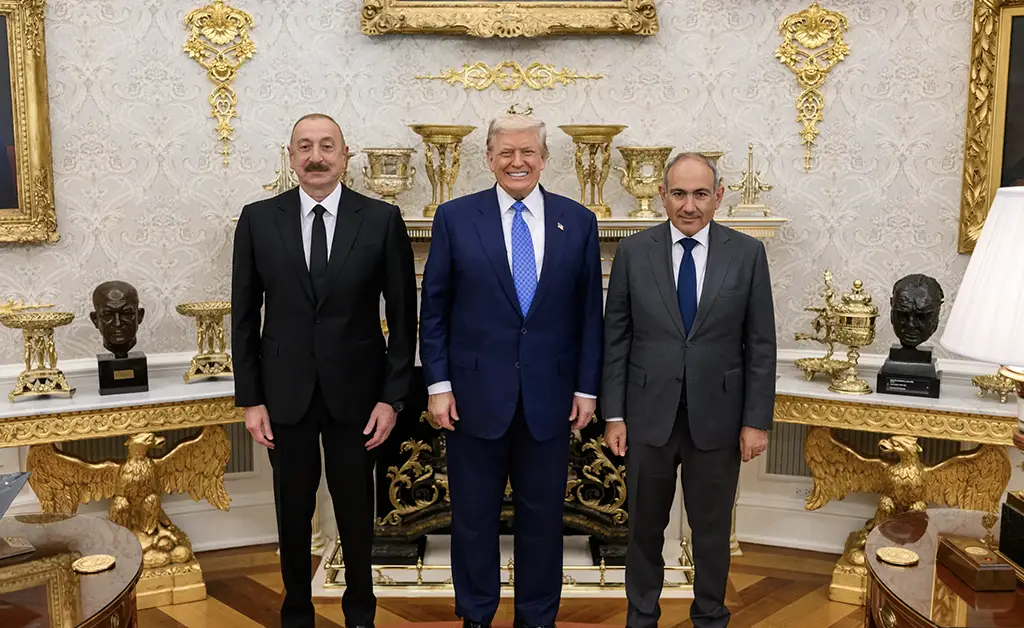
WASHINGTON — In a historic move, the United States has successfully brokered a peace framework between Azerbaijan and Armenia, bringing decades of hostilities closer to an end while also opening the door to new trade and investment opportunities in the South Caucasus.
On August 8, 2025, President Donald Trump hosted Azerbaijani President Ilham Aliyev and Armenian Prime Minister Nikol Pashinyan at the White House, where the leaders signed a U.S.-mediated agreement known as the Trump Route for International Peace and Prosperity (TRIPP).
The TRIPP agreement establishes a transit corridor linking Azerbaijan to its exclave of Nakhchivan, running through Armenian territory. Under the deal, U.S. companies will gain long-term rights to build and operate infrastructure along the route, including highways, energy pipelines, logistics hubs, and fiber optic networks. Officials described it as a 99-year concession, symbolizing Washington’s long-term commitment to the region.
“This is not only a peace deal but a major economic initiative,” President Trump said during the signing ceremony. “It will foster stability, create thousands of jobs, and strengthen America’s partnerships in a strategically vital part of the world.”
For Azerbaijan, the deal provides a secure land connection to Nakhchivan and beyond, while Armenia is expected to benefit from transit revenues and investment in local infrastructure. Analysts suggest the agreement could transform the South Caucasus into a key corridor for trade between Central Asia, Europe, and the Middle East.
The United States views the arrangement as part of its broader strategy to counter Russian and Iranian influence in the region while positioning American businesses at the forefront of new infrastructure and energy projects. Several U.S. firms in the construction, logistics, and renewable energy sectors are already preparing bids for projects tied to the corridor.
Critics, however, warn that the deal could trigger pushback from regional powers, particularly Iran, which has expressed concerns over U.S. involvement in new transit routes. Still, both Azerbaijani and Armenian officials hailed the White House agreement as a turning point for peace and prosperity.
If fully implemented, the TRIPP corridor could reshape regional trade flows, strengthen U.S. economic ties with the Turkic Republics, and provide a new platform for American businesses seeking entry into Eurasian markets.
