
Key Takeaways
- Cove Kaz Capital Group, a portfolio company of New York-based Cove Capital, holds 70% of Severniy Katpar LLP; Kazakhstan’s national mining company Tau-Ken Samruk holds 30%.
- Development costs for the Northern Katpar and Upper Kairakty tungsten deposits are estimated at $1.1 billion, and the Export-Import Bank of the United States issued a letter of interest for $900 million.
- The share purchase closed on April 29, 2026; an upgraded Definitive Feasibility Study is set to start in the second half of 2026.
- Cove Kaz says it will build mining and downstream processing and refining operations, a key point for non-Chinese tungsten supply.
The Cove Capital Project in Numbers
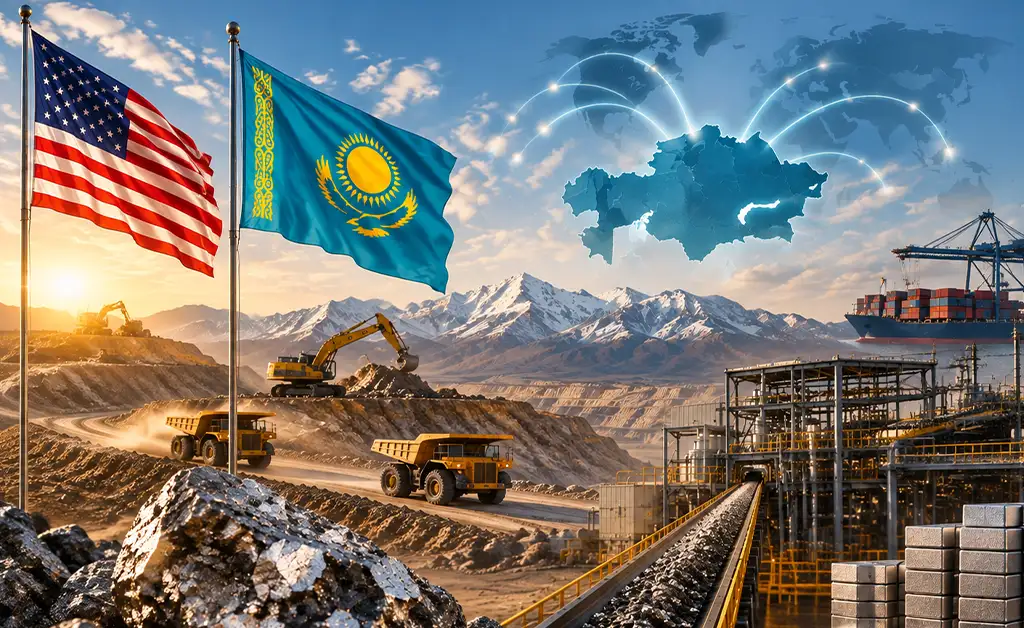
For the first time, the financial and structural detail of America’s tungsten play in Kazakhstan has been published in one place. Cove Capital holds 70 per cent and the state holding company Tau-Ken Samruk holds 30 per cent of a $1.1 billion project developing the Severny Katpar and Verkhneye Kairakty deposits in the Karaganda region.
In This Article
Northern Katpar is expected to produce roughly 5,000 tonnes a year, and Cove Kaz puts combined output from both deposits at about 12,000 tonnes a year, or roughly 15% of current global production, according to its April 29, 2026, release. Mining is scheduled to begin in 2030. Critically, processing will be carried out inside Kazakhstan rather than exported as raw concentrate.
Each of those four elements — the ownership split, the volume, the timeline and the domestic processing commitment — tells a different part of the story, and each carries a different implication for American industrial buyers.
Why Does Tungsten Matter for US Supply Chains?
Tungsten sits in an awkward position within the critical minerals conversation. It attracts less attention than rare earths or lithium, but it is functionally irreplaceable in cutting tools, armour penetrators, drilling equipment and high-temperature alloys. There is no substitute of comparable hardness at comparable cost.
It is also among the most concentrated supply chains in the industrial economy, with Chinese producers holding a dominant share of both mining and, more importantly, processing. A Western mine that ships concentrate to Chinese refineries has not diversified anything. That is why the domestic processing element of the Kazakh project is the detail worth dwelling on.
How Is the Cove Kaz and Tau-Ken Samruk Joint Venture Structured?
The ownership split is unusual for a Central Asian resource project of this scale. Majority foreign control with a minority state holding through Tau-Ken Samruk gives the commercial partner operational latitude while keeping the sovereign wealth vehicle aligned with the project’s success.
For potential offtake partners, that structure reduces a familiar category of risk. Projects where the state holds a controlling stake are more exposed to shifts in domestic political priority; projects with no state participation at all are more exposed to permitting friction and local resistance. A 30 per cent sovereign stake is, in practice, a stabilising instrument.
It also signals something about Astana’s calculation. Kazakhstan has chosen to take value capture through processing and equity rather than through resource nationalism — a materially different model from the one that has frustrated Western investors elsewhere in the region.
When Will Kazakh Tungsten Reach US Buyers?
First production in 2030 means the project changes nothing about current-year supply. American defence primes, machine tool manufacturers and drilling equipment suppliers will source tungsten in 2027, 2028 and 2029 largely as they do today.
What the timeline does create is a procurement planning window. Offtake agreements for projects of this type are typically negotiated three to five years ahead of first production, because the financing depends on them. That places the practical decision point for American buyers somewhere between now and 2028.
Firms that wait until 2030 to think about non-Chinese tungsten will be negotiating for residual volumes at spot-linked pricing. Firms that engage during the financing phase will be negotiating as counterparties whose commitment the project needs.
The regional pattern
The Kazakh tungsten project is not isolated. In Tajikistan, the Anzob facility operated by Comsup Commodities produces around 22,000 tonnes of antimony a year — approximately one-fifth of estimated global output in 2025. Uzbekistan has announced a portfolio of 120 technological metals projects worth $4.2 billion for the 2026 to 2030 period.
Taken together, these represent the first time American-linked critical minerals activity in Central Asia can be described at the level of named projects, identified operators and specific tonnages rather than as memoranda of understanding. That is a meaningful change in the maturity of the story.
It also arrived in the same week as a Congressional hearing on Kazakh critical minerals — a coincidence of timing that raises the political salience of both.
What This Means for Turkish American and Turkic Businesses
US defense suppliers, machine tool makers and drilling equipment companies that use tungsten should map where it enters their supply chain and follow the project’s feasibility and financing milestones, since offtake talks usually start well before first production.
Kazakh American and Turkish American firms in trading, logistics, engineering and compliance can support the project’s US-facing supply chain. An EXIM letter of interest is not a financing commitment, so buyers should track final EXIM or DFC approvals before relying on the timeline.
What to watch
The markers that will indicate whether this project is on track: confirmation of the debt financing package, which for a $1.1 billion capital programme will require either development finance participation or a substantial offtake-backed structure; announcements of processing technology partners, since the domestic refining commitment requires capability Kazakhstan does not currently hold at scale; and the first named offtake agreements, which will reveal whether American or European buyers move first.
For American defence and machine tool suppliers, the immediate task is unglamorous: establish whether tungsten appears in your bill of materials at all, and where in the tier structure it enters. A surprising number of firms discover the exposure only when the price moves.
Kazakhstan Tungsten Project at a Glance
| Item | Detail |
|---|---|
| Deposits | Northern Katpar (Severny Katpar) and Upper Kairakty (Verkhneye Kairakty), Karaganda region |
| Ownership | Cove Kaz Capital Group 70%, Tau-Ken Samruk 30% (Severniy Katpar LLP) |
| Estimated development cost | $1.1 billion |
| US financing signal | EXIM letter of interest for $900 million (November 2025) |
| Anticipated output | About 5,000 tonnes a year from Northern Katpar and 7,000 from Upper Kairakty |
| Next milestone | Upgraded Definitive Feasibility Study from the second half of 2026 |
Frequently Asked Questions
Who owns the Kazakhstan tungsten project?
Cove Kaz Capital Group, a portfolio company of New York-based Cove Capital LLC, owns 70% of Severniy Katpar LLP. Kazakhstan’s national mining company Tau-Ken Samruk retains 30%. The share purchase closed on April 29, 2026, according to Cove Kaz.
How much will the Kazakhstan tungsten project cost?
Total development costs for the Northern Katpar and Upper Kairakty deposits are estimated at about $1.1 billion. The Export-Import Bank of the United States issued a letter of interest for up to $900 million, which signals interest but is not a final loan approval.
How much tungsten could the project produce?
Cove Kaz expects about 5,000 tonnes a year from Northern Katpar and 7,000 tonnes from Upper Kairakty, about 12,000 tonnes combined, which it describes as roughly 15% of current global production.
Sources
- Cove Kaz Capital Group via Business Wire, Cove Kaz Capital Group Completes Financial Transaction to Acquire Majority Ownership in Tungsten Joint Venture in Kazakhstan, April 29, 2026. Accessed November 16, 2026.
- Cove Capital via Business Wire, U.S. Based Cove Capital LLC and Kazakhstan’s National Mining Company Announce Joint Venture, November 6, 2025. Accessed November 16, 2026.
Related Coverage
- Uzbekistan Quietly Sidelines Rosatom — Is There an Opening for American Nuclear Technology?
- Washington Calls Them Transshipment Hubs — and Also Its Critical Minerals Partners: The Tier III Problem for Azerbaijan and Kazakhstan
- Tungsten, Uranium, and $700 Million: How DFC and EXIM Are Financing Central Asia’s Minerals Buildout
About the American-Turkic Republics Business Alliance (ATBA)
The American-Turkic Republics Business Alliance (ATBA) is a New York-based nonprofit platform that strengthens trade, investment and business collaboration between the United States and the Turkic republics: Türkiye, Azerbaijan, Kazakhstan, Uzbekistan, Kyrgyzstan and Turkmenistan. Companies and professionals can join the network through ATBA membership.
