
Key Takeaways
- The White House Office of Trade and Manufacturing Policy released “The Great Transshipment Scam: Rise, Scope, and Costs” on August 13, 2026, naming more than 40 countries as elevated transshipment risks; the list matters for anyone sourcing through transshipment hubs.
- Azerbaijan, Georgia, Kazakhstan and Uzbekistan are in Tier 3, smaller economies with free zones, ports or limited customs capacity; Türkiye is in Tier 2.
- The report puts the value of goods implicated in illegal transshipment at roughly $40 billion to $303 billion a year and previews an AI tool, Detective Border, for CBP.
- US importers of record carry the liability in origin disputes, so documentation of substantial transformation is essential.
What Does the White House Transshipment Report Say?
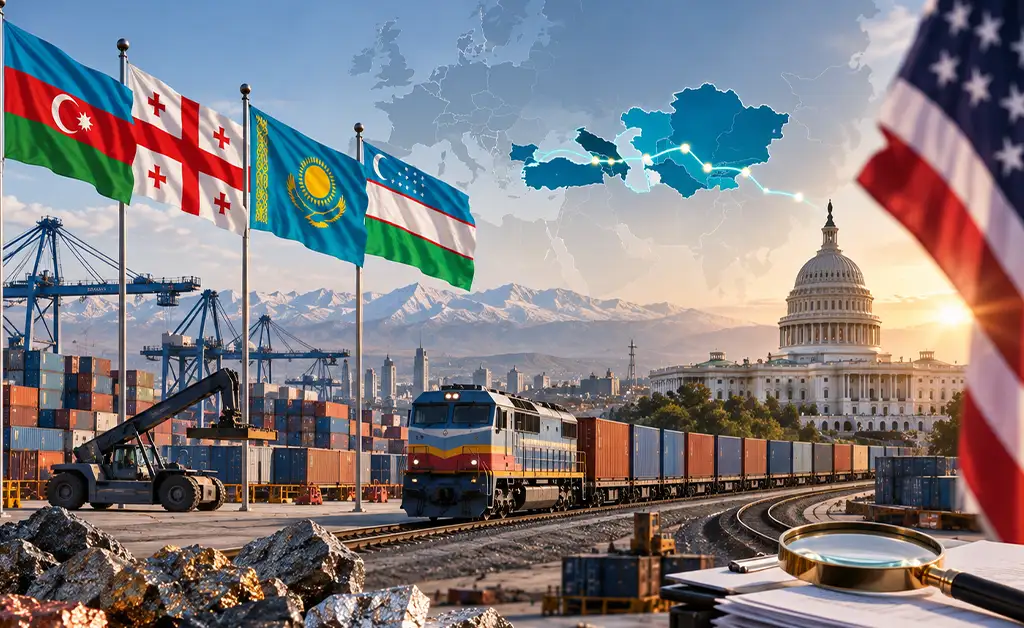
A White House report released on 13 August by the Office of Trade and Manufacturing Policy, titled ‘The Great Transshipment Scam‘, places Azerbaijan, Georgia, Kazakhstan and Uzbekistan in its Tier III category of transshipment hubs. The allegation is that rail and dry port transit, consolidation services and land-to-sea connections in these countries facilitate the movement of Chinese goods around American tariffs.
In This Article
The report estimates the value of goods implicated in illegal transshipment at roughly $40 billion to $303 billion a year — a range wide enough to indicate how contested the underlying methodology is — and names more than 40 countries in total.
The four Middle Corridor states named are, simultaneously, the countries with which Washington is building critical minerals partnerships and promoting east-west trade connectivity. That is not a subtle tension.
Turkic and Caucasus Countries in the Transshipment Report
| Country | Tier | Tier description |
|---|---|---|
| Türkiye | Tier 2 | Meaningful transshipment volumes and deeper integration into China-linked supply chains |
| Kazakhstan | Tier 3 | Smaller economies with free zones, port access, bonded warehousing or limited customs capacity |
| Uzbekistan | Tier 3 | Same as above |
| Azerbaijan | Tier 3 | Same as above |
| Georgia | Tier 3 | Same as above |
Why the same geography produces both stories
The contradiction is less mysterious than it appears. The infrastructure that makes the Middle Corridor commercially viable — rail interchange, dry ports, container consolidation, multimodal transfer between Caspian shipping and land routes — is the same infrastructure that makes origin obscuration possible.
A consolidation facility that allows a Kazakh exporter to combine partial loads for efficient onward shipment is functionally identical to one that allows Chinese goods to acquire a new commercial history. The distinction lies entirely in documentation and intent, not in the physical operation.
This means the tension will not resolve through infrastructure policy. It will resolve, if at all, through customs cooperation and documentary standards — which is a slower and less visible process than either tariff announcements or minerals agreements.
Who Bears the Risk of Transshipment Findings?
American importers should be clear about one thing: in a country-of-origin dispute, the liability sits with the importer of record. A Tier III designation applied to a transit country does not create a defence for a US buyer whose goods are subsequently found to be of Chinese origin. It creates the opposite — documented notice that the route carries elevated risk.
That has three practical consequences. First, importers sourcing through Middle Corridor routes should expect heightened scrutiny of origin documentation, and should be able to demonstrate substantive transformation rather than mere transit. Second, the evidentiary standard rises: commercial invoices and certificates of origin issued in a Tier III jurisdiction will carry less weight than production records, supplier audits and physical traceability. Third, penalty exposure is not limited to the duty differential.
None of this is a reason to avoid the corridor. It is a reason to document differently when using it.
What Does Good Transshipment Compliance Look Like?
Firms with genuine Central Asian supply relationships should be building a file that would survive a challenge. That means supplier questionnaires that establish where value is added rather than where goods were loaded; production capacity verification, since a supplier’s stated output should be consistent with the volumes invoiced; retained transport documentation showing the full routing rather than only the final leg; and periodic physical verification for higher-value categories.
For firms whose Central Asian suppliers are recent additions with limited operating history, the appropriate posture is more sceptical. Rapid emergence of new suppliers in a jurisdiction newly identified for transshipment risk is the pattern the report describes.
The policy question underneath
For Baku, Astana and Tashkent, the designation is an irritant arriving at an awkward moment. All three are actively courting American investment in minerals, energy and logistics. Being named in a tariff evasion white paper complicates the pitch.
It also creates leverage. If Washington wants both the minerals partnerships and the enforcement outcome, customs cooperation agreements are the obvious currency — and the affected states have an incentive to offer them in exchange for having the designation revisited.
That is the most likely path to resolution, and it would be a good outcome for American importers, since improved documentary standards at origin reduce the burden that currently falls on the buyer.
What This Means for Turkish American and Turkic Businesses
For Turkish American and Turkic diaspora importers, being sourced from a Tier 2 or Tier 3 country does not make goods suspect, but it raises the evidentiary bar. Keep production records, supplier audits, bills of materials and full routing documents that prove where substantial transformation took place.
For exporters in Kazakhstan, Uzbekistan, Azerbaijan and Türkiye selling to the United States, investing in traceability and origin certification is now a sales advantage. Companies should watch for CBP enforcement actions and any US customs cooperation agreements with the named countries. This is not legal advice; consult a licensed customs broker or trade attorney.
What to watch
Watch for any customs cooperation initiative between US Customs and Border Protection and the named states; for whether the Tier III designation begins to feature in actual enforcement actions rather than only in policy documents; and for the response from Azerbaijan and Kazakhstan, both of which have investment agendas that give them reason to engage rather than to dispute.
In the meantime, importers using the Middle Corridor should treat the white paper as what it is — a published statement that the route is under examination — and adjust their documentation accordingly, before the question is asked rather than after.
Frequently Asked Questions
What is the Great Transshipment Scam report?
It is a White House report titled “The Great Transshipment Scam: Rise, Scope, and Costs,” released on August 13, 2026, by the Office of Trade and Manufacturing Policy. It identifies more than 40 countries with elevated risk of illegal transshipment of Chinese-origin goods and outlines tougher enforcement.
Which Turkic countries are named in the transshipment report?
Kazakhstan, Uzbekistan and Azerbaijan are in Tier 3, alongside Georgia, as smaller economies the report says offer free zones, port access or limited customs capacity. Türkiye is in Tier 2, a group with larger transshipment volumes and deeper links to China-linked supply chains.
Does being named in the report mean goods from these countries face new tariffs?
No. The report does not change tariff rates. It signals stronger enforcement against relabeling, re-invoicing and false origin claims. Goods that undergo genuine substantial transformation in these countries keep their origin, but importers should expect more scrutiny of documentation.
Sources
- The White House, Office of Trade and Manufacturing Policy, The Great Transshipment Scam: Rise, Scope, and Costs (PDF), August 13, 2026. Accessed November 16, 2026.
- International Trade Insights (Holland & Knight), White House Previews AI-Powered Detective Border Tool Targeting Chinese Transshipment, August 2026. Accessed November 16, 2026.
Related Coverage
- Uzbekistan Quietly Sidelines Rosatom — Is There an Opening for American Nuclear Technology?
- Inside the $1.1 Billion Tungsten Deal: How Cove Capital and Tau-Ken Samruk Are Building a Non-Chinese Supply Chain in Kazakhstan
- Tungsten, Uranium, and $700 Million: How DFC and EXIM Are Financing Central Asia’s Minerals Buildout
About the American-Turkic Republics Business Alliance (ATBA)
The American-Turkic Republics Business Alliance (ATBA) is a New York-based nonprofit platform that strengthens trade, investment and business collaboration between the United States and the Turkic republics: Türkiye, Azerbaijan, Kazakhstan, Uzbekistan, Kyrgyzstan and Turkmenistan. Companies and professionals can join the network through ATBA membership.
