
What the report says
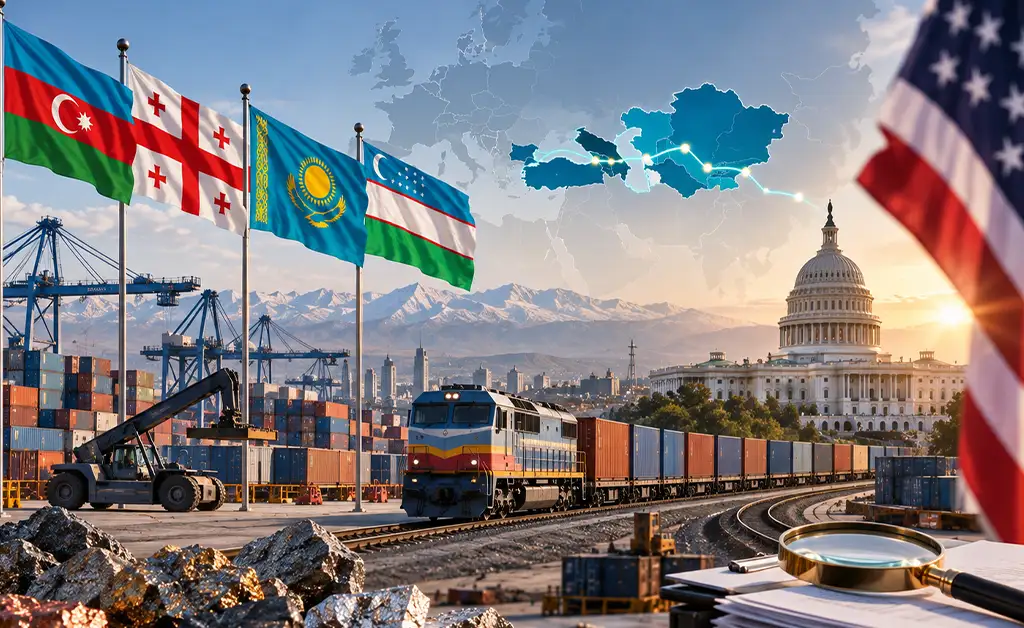
A White House white paper dated 21 August, titled ‘The Great Transshipment Scam’, places Azerbaijan, Georgia, Kazakhstan and Uzbekistan in its Tier III category. The allegation is that rail and dry port transit, consolidation services and land-to-sea connections in these countries facilitate the movement of Chinese goods around American tariffs.
The report estimates the annual cost to the US Treasury at between $40 billion and $303 billion — a range wide enough to indicate how contested the underlying methodology is — and names more than 40 countries in total.
The four Middle Corridor states named are, simultaneously, the countries with which Washington is building critical minerals partnerships and promoting east-west trade connectivity. That is not a subtle tension.
Why the same geography produces both stories
The contradiction is less mysterious than it appears. The infrastructure that makes the Middle Corridor commercially viable — rail interchange, dry ports, container consolidation, multimodal transfer between Caspian shipping and land routes — is the same infrastructure that makes origin obscuration possible.
A consolidation facility that allows a Kazakh exporter to combine partial loads for efficient onward shipment is functionally identical to one that allows Chinese goods to acquire a new commercial history. The distinction lies entirely in documentation and intent, not in the physical operation.
This means the tension will not resolve through infrastructure policy. It will resolve, if at all, through customs cooperation and documentary standards — which is a slower and less visible process than either tariff announcements or minerals agreements.
Where the risk actually lands
American importers should be clear about one thing: in a country-of-origin dispute, the liability sits with the importer of record. A Tier III designation applied to a transit country does not create a defence for a US buyer whose goods are subsequently found to be of Chinese origin. It creates the opposite — documented notice that the route carries elevated risk.
That has three practical consequences. First, importers sourcing through Middle Corridor routes should expect heightened scrutiny of origin documentation, and should be able to demonstrate substantive transformation rather than mere transit. Second, the evidentiary standard rises: commercial invoices and certificates of origin issued in a Tier III jurisdiction will carry less weight than production records, supplier audits and physical traceability. Third, penalty exposure is not limited to the duty differential.
None of this is a reason to avoid the corridor. It is a reason to document differently when using it.
What good compliance looks like here
Firms with genuine Central Asian supply relationships should be building a file that would survive a challenge. That means supplier questionnaires that establish where value is added rather than where goods were loaded; production capacity verification, since a supplier’s stated output should be consistent with the volumes invoiced; retained transport documentation showing the full routing rather than only the final leg; and periodic physical verification for higher-value categories.
For firms whose Central Asian suppliers are recent additions with limited operating history, the appropriate posture is more sceptical. Rapid emergence of new suppliers in a jurisdiction newly identified for transshipment risk is the pattern the report describes.
The policy question underneath
For Baku, Astana and Tashkent, the designation is an irritant arriving at an awkward moment. All three are actively courting American investment in minerals, energy and logistics. Being named in a tariff evasion white paper complicates the pitch.
It also creates leverage. If Washington wants both the minerals partnerships and the enforcement outcome, customs cooperation agreements are the obvious currency — and the affected states have an incentive to offer them in exchange for having the designation revisited.
That is the most likely path to resolution, and it would be a good outcome for American importers, since improved documentary standards at origin reduce the burden that currently falls on the buyer.
What to watch
Watch for any customs cooperation initiative between US Customs and Border Protection and the named states; for whether the Tier III designation begins to feature in actual enforcement actions rather than only in policy documents; and for the response from Azerbaijan and Kazakhstan, both of which have investment agendas that give them reason to engage rather than to dispute.
In the meantime, importers using the Middle Corridor should treat the white paper as what it is — a published statement that the route is under examination — and adjust their documentation accordingly, before the question is asked rather than after.
