
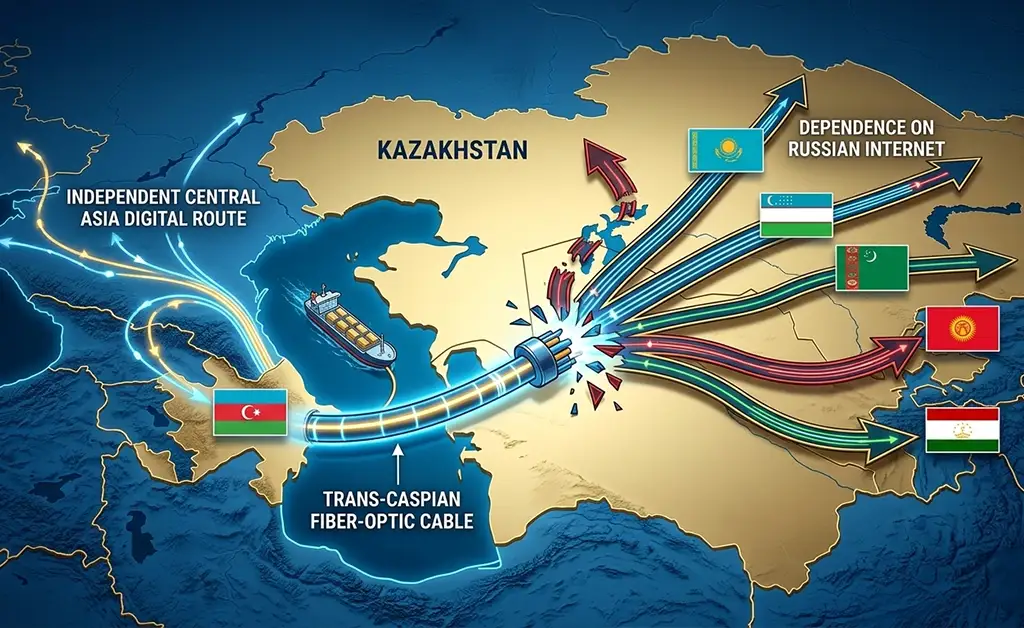
A 380 kilometer fiber optic cable running along the floor of the Caspian Sea is on track to become operational in the third quarter of 2026 and when it does, it will mark the most significant shift in Central Asia’s digital geography since the Soviet Union’s collapse. The Trans Caspian Fiber Optic Cable, connecting Sumgayit in Azerbaijan to Aktau in Kazakhstan, will for the first time give the region a direct, high capacity internet route to Europe that bypasses Russian network infrastructure entirely.
The stakes are structural. At present, approximately 95 percent of Kazakhstan’s internet traffic transits Russian controlled networks. Uzbekistan’s situation is even more acute: its international connections must first pass through Kazakhstan and then through Russia, where the Kremlin has significantly tightened its grip on internet routing since launching its full scale invasion of Ukraine in February 2022. The Trans Caspian Cable, with a designed transmission capacity of up to 400 terabits per second, will create an alternative corridor linking Central Asia through Azerbaijan, Georgia, and Turkey to European internet exchange points with minimal latency and no Russian intermediary.
Construction and timeline
The project is a joint venture between AzerTelecom, the backbone internet operator of Azerbaijan and a wholly owned subsidiary of NEQSOL Holding, and Kazakhtelecom, Kazakhstan’s national telecommunications operator. The two companies signed a construction agreement in March 2025 in the presence of the prime ministers of both countries. In April 2025, the project awarded a supervision services contract to US based Pioneer Consulting to ensure that all milestones meet international industry standards. A desktop study a comprehensive pre engineering analysis of the Caspian seabed environment and cable route was completed in May 2025.
The US dimension: digital sovereignty as strategic priority
Washington’s interest in the Trans Caspian Cable is closely tied to its broader C5+1 economic agenda. US officials and strategic analysts have explicitly framed the reduction of Central Asia’s dependence on Russian and Chinese digital infrastructure as aligned with American interests. Just as the United States has backed Trans Caspian energy pipeline projects and the Middle Corridor as physical trade route alternatives to Russian and Chinese dominated routes, digital connectivity infrastructure is increasingly viewed through the same lens.
Carnegie Endowment analysts noted in an April 2026 assessment that Central Asia’s internet routing dependency on Russia a legacy of Soviet era telecommunications architecture represents a significant vulnerability for the region’s long term economic sovereignty. The Trans Caspian Cable directly addresses this, and its routing through Azerbaijan aligns with Azerbaijan’s established role as the gateway for Europe bound Central Asian trade and energy exports. Kazakhstan has separately entered connectivity agreements with Amazon’s Kuiper satellite constellation and SpaceX Starlink to build out rural coverage, further diversifying its digital infrastructure stack.
Competition with Chinese digital investment
The cable’s completion will not neutralize Chinese digital influence in the region. Chinese firms are committing enormous sums to Central Asian data center infrastructure: Shanghai LinkWise has announced a $3.5 billion GPU powered computing center in Uzbekistan’s Karakalpakstan region, and Inspur Yunzhou is building a big data project in Kyrgyzstan. By contrast, Western digital infrastructure investment in the region remains limited, with the notable exception of the DataVolt commitment of over 4.6 billion euros to green data centers in Uzbekistan by 2030.
For Kazakhstan and Uzbekistan, the Trans Caspian Cable is not an act of alignment against any power both countries have been consistent in pursuing multi vector foreign policies and have made clear they will engage with all investors. But the cable’s implications are strategically unambiguous: it creates a physical internet route whose governance is not controlled by Moscow or Beijing. That alone makes it one of the most consequential pieces of infrastructure to come online in the Eurasian digital landscape in 2026 and a development that Washington has every reason to welcome and support.
