
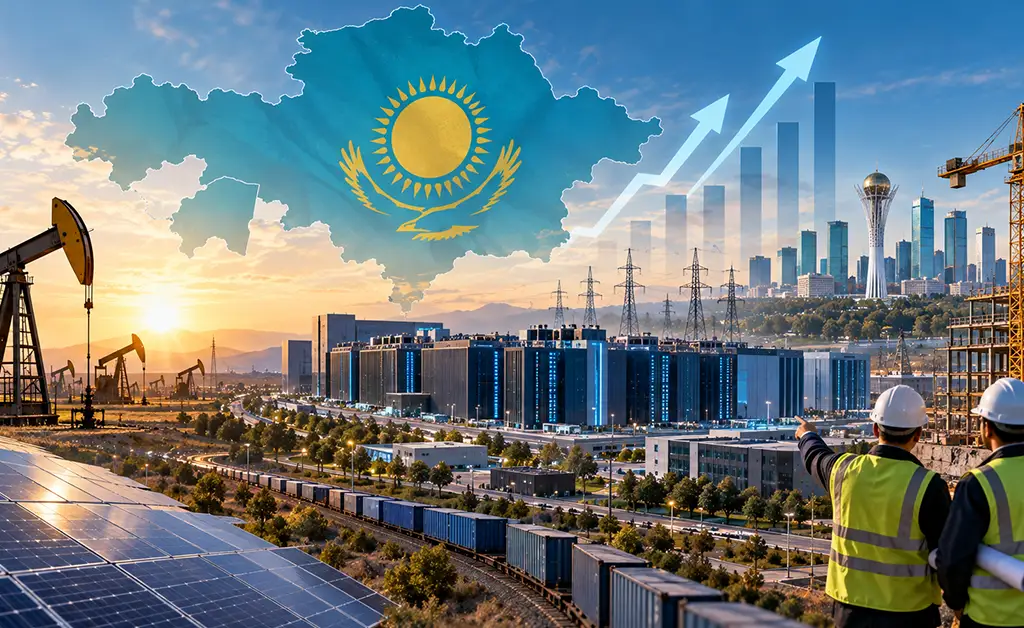
ASTANA — The government of Kazakhstan has officially initiated a massive new capital investment cycle encompassing 215 major projects valued at a collective 78.6 billion US dollars. Announced on 9 September 2026, the comprehensive economic program is structured to accelerate industrial modernization, expand digital infrastructure, and deepen domestic manufacturing capabilities across the nation. Official records indicate that 66 target investment agreements worth 17.8 trillion tenge have been finalized, with 25 agreements valued at 4.4 trillion tenge executed since the beginning of 2026.
This capital deployment builds upon strong macroeconomic foundations established over recent years. Foreign direct investment into Kazakhstan expanded by 14.4 per cent in 2025, reaching 20.5 billion dollars. Manufacturing sector investments experienced an exceptional surge, tripling to 3 trillion tenge. State planning documents reveal that project allocations span advanced manufacturing, renewable energy, transport infrastructure, artificial intelligence, and mineral extraction. For international equipment suppliers and engineering firms, accessing the official kazakhstan investment projects 2026 list identifies specific commercial procurement pipelines across key growth sectors.Fast Track Framework and Digital Investment Platform Deployment
To ensure rapid project execution, Kazakh authorities have implemented specialized administrative mechanisms to eliminate bureaucratic delays for international investors. A key component of this effort is the Fast Track approval procedure, designed to expedite regulatory clearances, land allocation, and utility connections for approved commercial projects.
Simultaneously, the government has launched the National Digital Investment Platform, an integrated online portal that provides real-time tracking of project milestones, administrative approvals, and investor support services. This digital framework allows foreign companies to submit applications, monitor regulatory compliance, and access investment incentives directly. Obtaining a formalized kazakhstan fast track investment agreement offers international exporters legal protections, tax concessions, and prioritized administrative handling, significantly reducing market entry lead times.High Capacity Infrastructure, Energy Grids, and Upstream Exploration
Among the flagship capital initiatives, the 30 billion dollar Data Center Valley project located in Ekibastuz represents a major technological undertaking. Designed to leverage regional power generation assets, the project aims to position Kazakhstan as a primary artificial intelligence and cloud computing hub across Eurasia. The initiative creates immediate procurement demand for advanced cooling technology, high performance servers, and electrical grid infrastructure. Foreign technology vendors seeking sub-contracting roles can engage directly with ekibastuz data center valley suppliers across multiple construction phases.
Substantial investment is also directed toward upgrading municipal energy networks and expanding natural resource exploration. On 7 September 2026, the European Bank for Reconstruction and Development extended a 102 billion tenge, or 194 million euro, long-term loan to Alatau Zharyk Company to modernize the electrical distribution infrastructure of Almaty. In the upstream energy sector, the Ministry of Energy has streamlined basin allocation rules to accelerate exploration, targeting 80 new exploratory wells in 2026 and 120 wells annually during 2027 and 2028. These diverse infrastructure projects offer continuous export opportunities for specialized machinery, power distribution equipment, and drilling technology.Institutional Financial Reforms and Capital Market Depth Constraints
To support long-term capital formation, Kazakh financial leaders are pursuing structural reforms within domestic capital markets. Speaking at the Astana Finance Days conference on 9 and 10 September 2026, Central Bank Governor Timur Suleimenov called for developing a less bank-centric financial system and expanding local securities markets. Astana International Financial Centre Governor Renat Bekturov noted that improving market liquidity depth remains a key operational requirement to support corporate bond issuances and equity listings.
For international capital equipment vendors and commercial exporters, export credit agencies provide essential financial bridge financing. Entities such as the Export-Import Bank of the United States and the US International Development Finance Corporation maintain active engagement in the region, offering letters of interest, loan guarantees, and political risk insurance for qualified export transactions. By leveraging international trade finance instruments alongside Kazakhstan’s Fast Track administrative framework, global exporters can secure long-term commercial positioning within Central Asia’s largest economy.
