
Key Takeaways
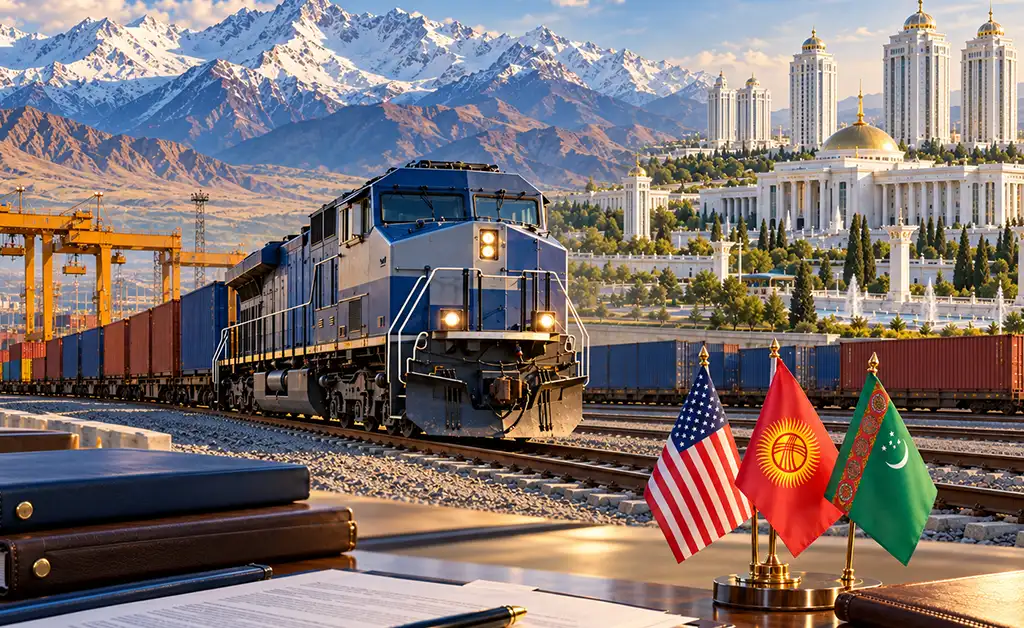
- Kyrgyzstan’s national railway, Kyrgyz Temir Zholu, is buying 10 Wabtec TE33AC mainline freight locomotives, with deliveries expected by the end of 2027.
- The US Department of Commerce put the contract value at $53 million for up to 10 locomotives, Economist.kg reported.
- President Sadyr Japarov met EXIM Chairman John Jovanovic, Under Secretary of Commerce William Kimmitt and Wabtec in New York in September 2026; Jovanovic called it one of the first projects of its kind in US-Kyrgyz cooperation.
- The new locomotives will renew about 30% of Kyrgyz Temir Zholu’s fleet.
Why the EXIM-Backed Wabtec Order Is Worth Studying
Kyrgyzstan has placed an EXIM-backed Wabtec order for ten locomotives, with financing support from the Export-Import Bank of the United States.
In This Article
For a mid-sized American exporter, this is more instructive than any policy announcement. It is a complete, replicable template: a Central Asian state procurement, an American manufacturer, and official export credit closing the financing gap that would otherwise have sent the order to a supplier arriving with its own state-backed terms.
The pattern it demonstrates is the one that determines most equipment competitions in the region. Technical specification is rarely the deciding factor. Financing terms usually are.
Why Is Kyrgyzstan More Accessible Than It Appears?
The macroeconomic picture supports the case. EBRD data records fixed capital investment growth of 58.8 per cent — an extraordinary figure, reflecting a small base but also a genuine construction and modernisation cycle.
The banking infrastructure is opening in parallel. A memorandum with Citibank points towards improved correspondent banking arrangements, which matter more to exporters than their profile suggests: payment mechanics, letters of credit and currency settlement are frequently the practical obstacle in smaller markets, not demand.
Taken together, a growing investment cycle, improving banking rails and demonstrated EXIM appetite make Kyrgyzstan a market where an American exporter can realistically structure a transaction.
Which Sectors Fit US Exporters in Kyrgyzstan?
Three categories align with the current cycle. Rail and transport equipment, where the Wabtec order establishes both precedent and reference. Energy equipment, particularly generation and grid components tied to the country’s hydropower resources. And construction and mining machinery, following the fixed capital investment data.
In each case the entry route is the same: identify the procuring entity, establish EXIM eligibility early, and structure the financing before the technical proposal rather than after.
Why Is Turkmenistan’s Investment Slowing?
Turkmenistan presents a different picture. Investment growth has slowed to approximately 3.5 per cent — a marked deceleration that has prompted an active search for external capital.
The Turkmenistan Investment Forum, convened in Ashgabat with participation reported from around 45 countries, is the principal expression of that effort. Forums of this kind, held by a country seeking to reverse an investment slowdown, tend to produce more accessible terms than those held from a position of strength.
For American suppliers, the relevant sectors are gas processing and petrochemical equipment, power generation, and industrial and infrastructure projects where the country has capital commitments but limited domestic technical capacity.
The constraints to price honestly
Turkmenistan’s operating environment carries well-documented difficulties: currency convertibility and profit repatriation are the most frequently cited, alongside a restrictive regulatory environment and limited transparency.
The practical implication is that payment structure matters more than contract value. Transactions secured through letters of credit, escrow arrangements or official export credit are viable. Those relying on open account terms generally are not.
This is not a reason to disregard the market — it is one of the few places in the region where competition from Western suppliers is genuinely thin — but it is a reason to structure conservatively.
What This Means for Turkish American and Turkic Businesses
For mid-sized US exporters, the Kyrgyz order shows how a small Central Asian market can buy American equipment when US government finance and trade officials are involved early. Rail parts, signaling, maintenance and training suppliers should approach Kyrgyz Temir Zholu as the fleet renewal continues, since President Japarov has ordered a plan to replace the rest of the fleet within five years.
Turkic diaspora firms with Russian- and Kyrgyz-language capacity can support US suppliers with local partnering, logistics and after-sales service. In Turkmenistan, the same firms should insist on secured payment structures such as letters of credit or export credit cover.
What to watch
Three indicators: whether the Wabtec transaction is followed by further EXIM-supported Kyrgyz procurements, which would establish a pattern rather than a single case; whether Kyrgyzstan’s correspondent banking arrangements translate into smoother settlement in practice; and whether the Turkmenistan forum produces executed contracts or another round of memoranda.
For American exporters, the broader point is that competition in these two markets is close to absent. That is unusual, and it will not last indefinitely.
Kyrgyzstan’s Wabtec Locomotive Order at a Glance
| Item | Detail | Source |
|---|---|---|
| Buyer | National Company Kyrgyz Temir Zholu | Trend |
| Equipment | 10 Wabtec TE33AC mainline freight locomotives | Trend; Economist.kg |
| Contract value | $53 million for up to 10 locomotives | US Department of Commerce, via Economist.kg |
| Delivery | By the end of 2027 | Trend; Economist.kg |
| Fleet impact | About 30% of the locomotive fleet renewed | Trend |
Frequently Asked Questions
How many Wabtec locomotives is Kyrgyzstan buying?
Kyrgyzstan is buying 10 Wabtec TE33AC mainline freight locomotives for its national railway, Kyrgyz Temir Zholu. The US Department of Commerce described the contract as covering up to 10 locomotives, valued at $53 million, with deliveries expected by the end of 2027.
What role does EXIM play in the Kyrgyz locomotive deal?
EXIM Chairman John Jovanovic took part in the September 2026 New York meeting with President Sadyr Japarov and Wabtec and said the project is one of the first of its kind in US-Kyrgyz cooperation, Trend reported. Detailed financing terms have not been published.
Why does the order matter for US exporters?
It shows that a small Central Asian market can procure American capital equipment when financing and government support are aligned. President Japarov has also instructed officials to plan renewal of the rest of the locomotive fleet over the next five years, which could create further orders.
Sources
- Trend News Agency, Kyrgyzstan Set to Purchase New US-Based Wabtec Freight Locomotives, September 22, 2026. Accessed November 16, 2026.
- Economist.kg, US Discloses Value of Kyrgyzstan’s Wabtec Locomotive Contract (in Russian), October 8, 2026. Accessed November 16, 2026.
Related Coverage
- Azerbaijan as a Regional Base: The $201 Million Trans-Caspian Fund and What the USACC Playbook Signals
- Inside the World Bank’s $55 Billion Trans-Caspian Blueprint: What It Means for US Exporters
- The Middle Corridor’s Backhaul Gap: An Opening for US Exporters to Central Asia
About the American-Turkic Republics Business Alliance (ATBA)
The American-Turkic Republics Business Alliance (ATBA) is a New York-based nonprofit platform that strengthens trade, investment and business collaboration between the United States and the Turkic republics: Türkiye, Azerbaijan, Kazakhstan, Uzbekistan, Kyrgyzstan and Turkmenistan. Companies and professionals can join the network through ATBA membership.
