
Key Takeaways
- Most container traffic on the Middle Corridor moves westbound, from China and Central Asia toward Europe, leaving eastbound capacity underused.
- Carriers have an incentive to price eastbound cargo competitively rather than reposition empty equipment, which can benefit US exporters shipping to Kazakhstan, Uzbekistan and the wider region.
- Goods that fit the route are time-sensitive, high-value and destined for landlocked Central Asian markets.
- The World Bank’s September 28, 2026, report puts corridor investment needs at roughly $55 billion through 2040.
An imbalance most coverage misses
In This Article
Reporting on the Middle Corridor, a key route for US exporters to Central Asia, has concentrated almost entirely on volume growth — more containers, more rail capacity, shorter transit times. Less attention has been paid to the direction those containers travel.
Approximately 80 per cent of container movements on the route are westbound, carrying goods from China and Central Asia towards Europe. The eastbound leg is comparatively empty.
For carriers and operators, that asymmetry is a persistent cost problem. Empty containers must be repositioned, and the expense of doing so is recovered through westbound rates. For shippers moving cargo in the other direction, the same imbalance produces the opposite effect.
Why Does the Backhaul Gap Matter for US Exporters to Central Asia?
Carriers with capacity they would otherwise run empty have a structural incentive to price eastbound freight competitively. Any revenue on the return leg is better than repositioning at a loss.
This means exporters shipping from the United States or Europe into Kazakhstan, Uzbekistan and the wider region may find eastbound rates on the trans-Caspian route more favourable than volume-based logic would suggest. The route’s commercial economics are being shaped by the need to fill returning equipment rather than by demand on that leg.
The practical implication is that American exporters who have not examined Middle Corridor routing — perhaps assuming it to be a China-to-Europe corridor that does not concern them — may be leaving a cost advantage unexamined.
Which Goods Fit the Middle Corridor Route?
Not every consignment suits trans-Caspian routing. The categories that fit best share three characteristics.
They are time-sensitive relative to sea freight but not urgent enough to justify air. The Middle Corridor’s core proposition is a transit time between the two, and goods that gain nothing from arriving faster than sea freight will not justify the premium that remains.
They are destined for landlocked markets. For cargo terminating in Central Asia rather than transiting onward, the route avoids the additional handling and inland haulage that sea routing to a regional port would require.
They are of sufficient value density to absorb multimodal handling. Every transfer between rail, Caspian shipping and road adds cost and handling risk. High-value industrial equipment, components, pharmaceuticals and specialist machinery absorb that better than bulk commodities do.
What Should Exporters Check Before Using the Middle Corridor?
Exporters should confirm four things before routing freight this way. Caspian ferry capacity and scheduling, which remains the route’s principal bottleneck and is subject to weather and vessel availability. Customs procedures at each border crossing, since the corridor traverses multiple jurisdictions with differing documentation requirements. Insurance terms, which should explicitly cover multimodal transfer points. And the availability of equipment in the right specification, since not every container type is repositioned in equal numbers.
These are operational questions with known answers, and any experienced freight forwarder active on the route can address them. They are, however, questions worth asking before the first consignment rather than during it.
A data point worth tracking
A World Bank assessment of the Middle Corridor, released on September 28, 2026, provides independent measurement of capacity, cost structure and bottlenecks along the route.
Institutional analysis of this kind matters for exporters because it establishes a shared reference point for negotiation. Freight rate discussions conducted against published capacity and cost data proceed differently from those conducted on carrier assertion alone.
What This Means for Turkish American and Turkic Businesses
For US exporters of industrial equipment, components, pharmaceuticals and specialist machinery, eastbound Middle Corridor routing can be a cost-competitive alternative to sea freight plus long inland haulage into Central Asia. Ask freight forwarders for eastbound quotes via Georgia, Azerbaijan and the Caspian, and compare total landed cost and transit time.
Turkish American and Turkic diaspora logistics firms are well placed to consolidate US cargo through Türkiye and the South Caucasus. Before committing volume, confirm Caspian ferry schedules, customs documents at each border, multimodal insurance cover and container availability.
What to watch
Three indicators will show whether the backhaul gap narrows or persists: whether eastbound volumes grow faster than westbound, which would erode the pricing advantage; whether Caspian shipping capacity expands sufficiently to remove the scheduling constraint; and whether carriers begin marketing eastbound services actively rather than treating them as repositioning revenue.
For now, the imbalance is real and the opportunity is available to exporters willing to ask for it. The firms that benefit will be those that approach carriers with specific eastbound volumes rather than those waiting for the rates to be advertised.
Frequently Asked Questions
What is the Middle Corridor?
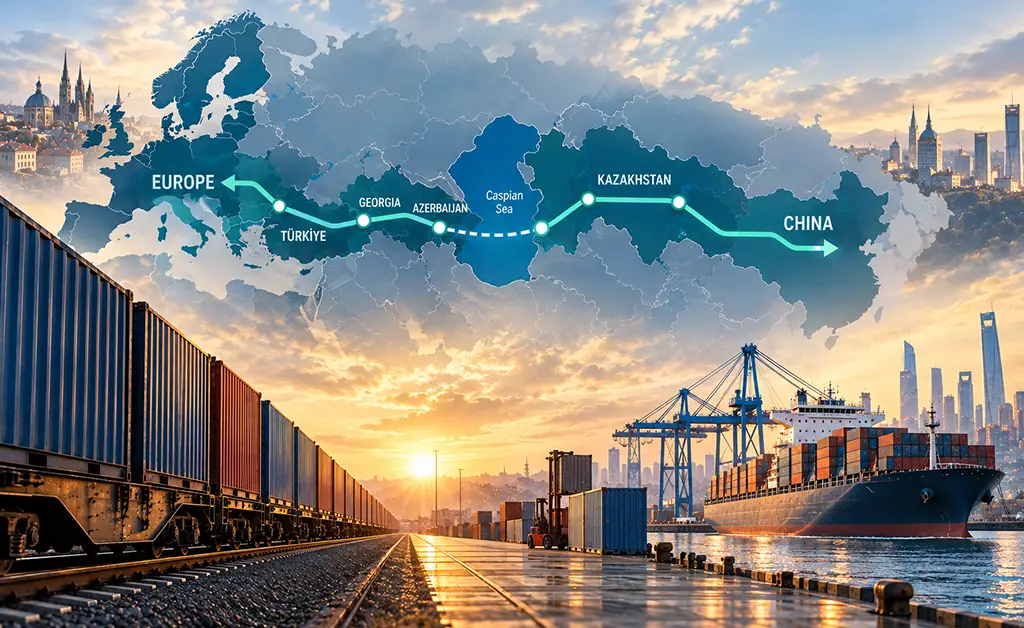
The Middle Corridor, also called the Trans-Caspian Transport Corridor, links China and Central Asia with Europe through Kazakhstan, the Caspian Sea, Azerbaijan, Georgia and Türkiye. It combines rail, Caspian shipping and road transport and avoids Russian territory.
Is the Middle Corridor useful for US exporters?
It can be, especially for higher-value goods bound for landlocked Central Asian markets. Because most traffic moves westbound, carriers may price eastbound cargo competitively. Exporters should still check Caspian ferry capacity, customs procedures and insurance before shipping.
What did the World Bank find about the Middle Corridor?
The World Bank’s September 28, 2026, report estimates more than $25 billion in physical infrastructure and about $30 billion in enabling investment are needed through 2040. With these investments, it says trade volumes could more than triple and travel times could halve.
Sources
- World Bank, Trans-Caspian Transport Corridor Investments Could Spur Growth and Create Millions of Jobs (press release), September 28, 2026. Accessed November 16, 2026.
Related Coverage
- Inside the World Bank’s $55 Billion Trans-Caspian Blueprint: What It Means for US Exporters
- Azerbaijan as a Regional Base: The $201 Million Trans-Caspian Fund and What the USACC Playbook Signals
- The Small-Market Opening: Kyrgyzstan’s EXIM-Backed Wabtec Order and Turkmenistan’s Investment Slowdown
About the American-Turkic Republics Business Alliance (ATBA)
The American-Turkic Republics Business Alliance (ATBA) is a New York-based nonprofit platform that strengthens trade, investment and business collaboration between the United States and the Turkic republics: Türkiye, Azerbaijan, Kazakhstan, Uzbekistan, Kyrgyzstan and Turkmenistan. Companies and professionals can join the network through ATBA membership.
