
Key Takeaways
- On August 8, 2025, Azerbaijan and Armenia initialed a peace agreement at the White House and signed a declaration on the TRIPP corridor, a transit route through southern Armenia.
- The January 2026 framework gives a US-majority TRIPP Development Company rights for an initial 49 years, extendable by 50.
- Planned TRIPP assets include rail, power, fiber-optic and gas lines, under Armenian sovereignty.
- Construction in Armenia is not expected before 2027.
WASHINGTON — In a historic move, the United States has successfully brokered a peace and economic deal between Azerbaijan and Armenia, bringing decades of hostilities closer to an end while also opening the door to new trade and investment opportunities in the South Caucasus.
In This Article
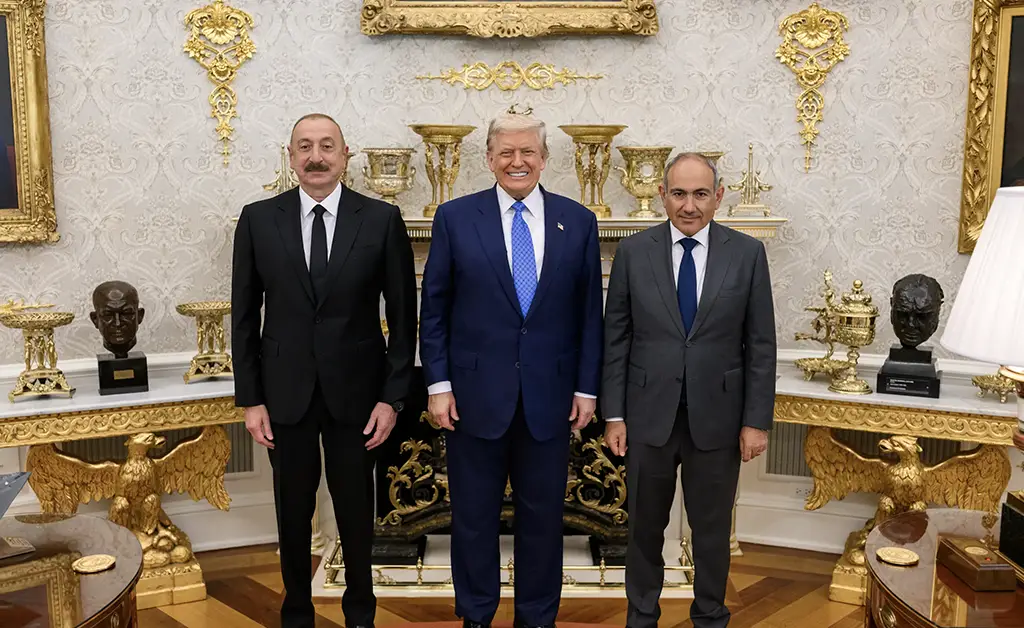
On August 8, 2025, President Donald Trump hosted Azerbaijani President Ilham Aliyev and Armenian Prime Minister Nikol Pashinyan at the White House. The leaders initialed the text of a peace agreement, without signing it, and signed a joint declaration that provides for the Trump Route for International Peace and Prosperity (TRIPP), according to the Carnegie Endowment.
What Does the TRIPP Corridor Include?
TRIPP is a planned transit route through southern Armenia linking mainland Azerbaijan with its Nakhchivan exclave. Under the TRIPP Implementation Framework published on January 13, 2026, a TRIPP Development Company, 74 percent owned by the United States and 26 percent by Armenia, is to hold development rights for an initial 49 years, extendable by 50 years, according to Armenia’s Foreign Ministry. Planned assets include a railway, power and fiber-optic lines and a gas pipeline, while infrastructure stays under Armenian sovereignty and jurisdiction.
For Azerbaijan, the deal provides a secure land connection to Nakhchivan and beyond, while Armenia is expected to benefit from transit revenues and investment in local infrastructure. Analysts suggest the agreement could transform the South Caucasus into a key corridor for trade between Central Asia, Europe, and the Middle East.
The United States sees the arrangement as a way to expand American commercial presence in a region where Russia and Iran have long been influential, and to connect the South Caucasus with Central Asian and European trade routes.
What Are the Risks to the TRIPP Corridor?
Risks remain. Iran has objected to US involvement in new transit routes on its northern border, and in September 2026 Azerbaijan’s foreign minister acknowledged that construction in Armenia would not start before 2027, Eurasianet reported. Both Azerbaijani and Armenian officials have nonetheless described the White House summit as a turning point.
If fully implemented, the TRIPP corridor could reshape regional trade flows, strengthen U.S. economic ties with the Turkic Republics, and provide a new platform for American businesses seeking entry into Eurasian markets.
What This Means for Turkish American and Turkic Businesses
For US construction, logistics, energy and telecom firms, the TRIPP Development Company will be the main procurement channel. Its US majority ownership may favor American contractors, but bids should account for delays and security risk near the Iranian border.
Turkish American and Azerbaijani American traders can prepare for a new overland link between Türkiye, Nakhchivan and mainland Azerbaijan, which would shorten routes for goods moving between Central Asia and Europe.
Frequently Asked Questions
Is TRIPP a 99-year concession?
Under the January 2026 framework, the TRIPP Development Company holds development rights for an initial 49 years, which can be extended by another 50 years, for up to 99 years in total.
Who owns the TRIPP Development Company?
Armenia intends to offer the United States a 74 percent stake and keep 26 percent for the initial 49-year term; Armenia’s stake would rise to 49 percent if the term is extended.
Was a final peace treaty signed in August 2025?
No. The leaders initialed the text of a peace agreement on August 8, 2025, and signed a joint declaration; the treaty itself was not signed at that summit.
Sources
- Carnegie Endowment for International Peace, Rewiring the South Caucasus: TRIPP and the New Geopolitics of Connectivity, March 2026. Accessed November 16, 2026.
- Ministry of Foreign Affairs of Armenia, Joint Statement on the Publication of the Armenia-U.S. Implementation Framework for TRIPP, January 14, 2026. Accessed November 16, 2026.
- Eurasianet, Start Date for TRIPP Trade Corridor Connecting Armenia and Azerbaijan Pushed Back, September 10, 2026. Accessed November 16, 2026.
- PanArmenian.net, Trump Route Construction to Start in 2026, MFA Says, December 25, 2025. Accessed November 16, 2026.
Related Coverage
- Trump Hosts Azerbaijani and Armenian Leaders at the White House as They Initial a Peace Agreement
- Azerbaijan Expands Gulf Partnerships: AmCham President Engages in Strategic Business Talks in Oman & Kuwait
- US and Azerbaijan Sign Over $8 Billion in Commercial Deals as Energy Ties Deepen
About the American-Turkic Republics Business Alliance (ATBA)
The American-Turkic Republics Business Alliance (ATBA) is a New York-based nonprofit platform that strengthens trade, investment and business collaboration between the United States and the Turkic republics: Türkiye, Azerbaijan, Kazakhstan, Uzbekistan, Kyrgyzstan and Turkmenistan. Companies and professionals can join the network through ATBA membership.
