
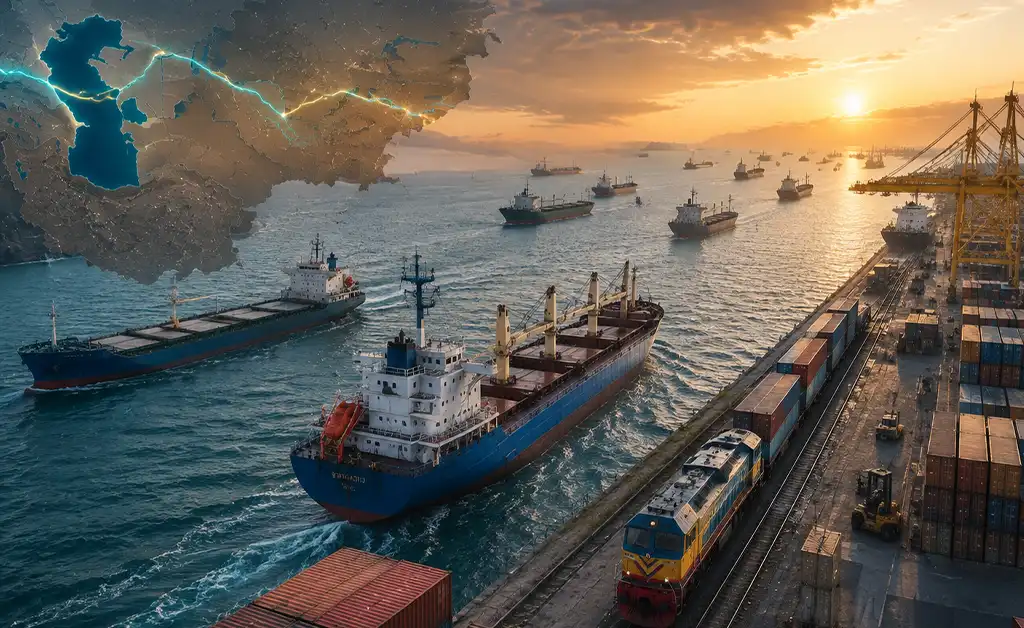
As geopolitical volatility and security crises continue to disrupt traditional maritime routes through the Suez Canal and Northern Eurasian rail corridors, the Trans-Caspian International Transport Route (TITR), widely known as the Middle Corridor, has emerged as a vital multimodal link between Asia and Europe. However, achieving maximum efficiency along this corridor requires systemic coordination. As Nurgul Zhakupova, General Secretary of the TITR Association, recently emphasized: “Transit times do not drop through a single isolated solution, but through the consistent and uniform modernization of all links along the chain.”
According to recent performance metrics, container traffic along the Middle Corridor reached approximately 77,000 TEU in 2025, representing an impressive 36% year-over-year increase, despite a slight decline in total bulk cargo volume. Backed by World Bank projections, which suggest that corridor volumes could triple by 2030 with targeted infrastructural investments, regional governments are aggressively funding deep-water port expansions, rail double-tracking, and digital customs integration.
The Middle Corridor Performance ScorecardTo help logistics directors and supply chain managers evaluate the viability of the route, the following table consolidates the key operational metrics, completed infrastructure projects, and near-term targets of the Middle Corridor:
| Operational Metric / Infrastructure Link | Baseline Performance | Current Status (2026) | Target Projections (2027-2029) |
|---|---|---|---|
| Annual Container Volume | ~56,000 TEU | ~77,000 TEU (36% growth) | Projected to triple by 2030 (World Bank) |
| China-Kazakhstan Container Trains | 600 trains annually | 600 trains active | 1,000 trains (2027) / 2,000 trains (2029) |
| Kuryk Port Ferry Handling Time | 18 hours | 12 hours (post-modernization) | Further reduction via automated loading |
| Baku-Tbilisi-Kars (BTK) Capacity | 1 million tons annually | 5 million tons (reached June 2026) | 5 million tons (operational capacity) |
| Customs Clearance Time | Multiple hours / days | ~30 minutes (via “Tez Customs”) | Fully paperless digital transit corridor |
Key Infrastructure Milestones AchievedThe dramatic improvements in transit speeds and cargo capacity along the Middle Corridor are the direct result of several major capital projects completed over the past year:
- Rail Double-Tracking: Kazakhstan completed the construction of the second track on the 836-kilometer Dostyk-Moyynty railway line, alongside the Almaty rail bypass, drastically reducing rail congestion at the Chinese border.1
- Port Efficiency: Modernized roll-on/roll-off (Ro-Ro) and ferry infrastructure at Kazakhstan’s Kuryk Port successfully reduced vessel loading and unloading times from 18 hours to just 12 hours.
- Baku-Tbilisi-Kars (BTK) Expansion: Following extensive construction, the BTK rail link reached full operational capacity in June 2026, boosting annual capacity from 1 million to 5 million tons.
- Digital Customs Integration: The deployment of the “Tez Customs” unified digital platform has reduced border customs clearance times to approximately 30 minutes, removing paper-based administrative friction.
Strategic Evaluation: When U.S. Cargo Owners Should Use the CorridorFor U.S.-based multinational corporations managing global supply chains, the Middle Corridor is not a universal replacement for ocean freight, but a highly effective, high-velocity alternative for specific scenarios.
When to Use the Middle Corridor:
- Time-Sensitive, High-Value Cargo: For shipments of electronics, automotive components, and high-value industrial machinery that cannot afford the 40-to-45-day ocean transit times around Africa, the Middle Corridor offers a reliable 12-to-15-day overland alternative.
- Mitigating Geopolitical Bottlenecks: When shipping routes through the Red Sea are blocked or subject to high war-risk insurance premiums, the Middle Corridor provides a secure, insurance-friendly transit path through politically aligned nations.
- Consolidated Eurasian Transit: Thanks to the unified gümrük (customs) protocols under Middle Corridor Multimodal Ltd. (a joint venture of Kazakh, Azerbaijani, and Georgian railways), cargo can transit multiple countries under a single bill of lading, minimizing administrative delays.
When to Re-evaluate or Seek Alternatives:
- Low-Margin Bulk Commodities: For massive, low-margin shipments of grain, coal, or raw minerals, the higher cost per ton of overland rail transit compared to standard maritime container shipping may not justify the speed advantages.
- Winter Weather and Caspian Seasonal Fluctuations: Falling water levels in the Caspian Sea can occasionally restrict the draft depth of cargo vessels, temporarily limiting carrying capacities during dry seasons. Shippers must monitor water level updates and coordinate closely with port operators during these periods.
