
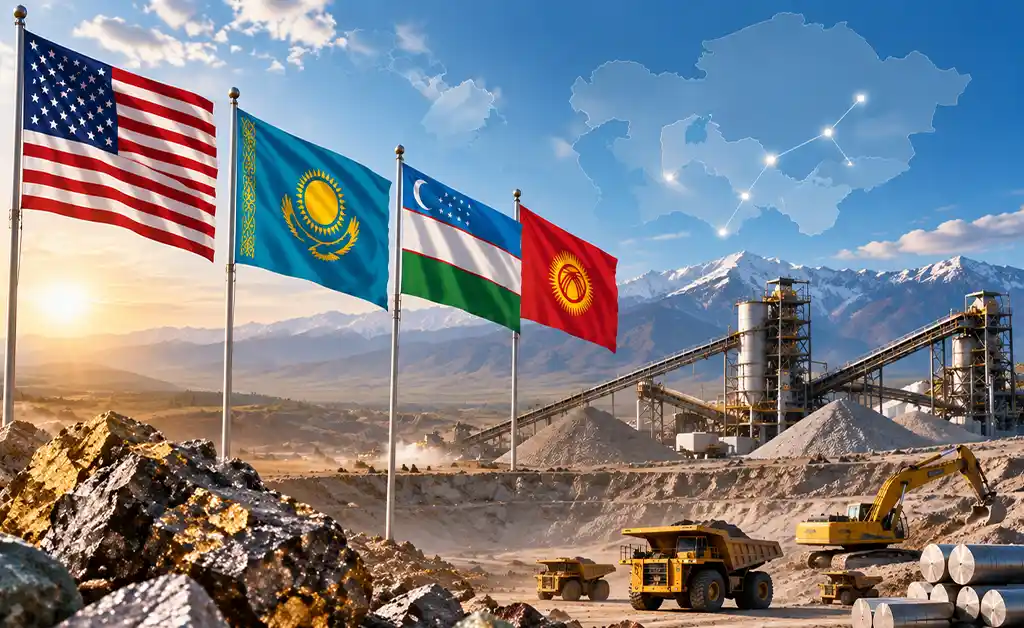
The United States is actively executing a long-term economic strategy to secure and diversify its critical mineral supply chains, moving away from monopolistic, single-source dependencies. This strategy has led to the development of an “allied critical mineral economy” architecture, which formally positions Central Asian nations—such as Kazakhstan and Uzbekistan—as key partners alongside traditional allies like Australia, Canada, and Japan. Rather than treating the region solely as a source of raw ore extraction, the U.S. is funding processing, refining, financing, and transport infrastructure to build resilient, high-value supply chains.
To drive this strategy, the U.S. International Development Finance Corporation (DFC) and the Export-Import Bank of the United States (EXIM) have deployed significant capital. By aligning American developmental finance with regional mining and energy initiatives, these institutions are creating robust pathways for U.S. technology providers and equipment exporters.
Financing Key Capital Projects: Severniy Katpar and BeyondThe most prominent U.S. financial initiative in the region is DFC’s ongoing evaluation of a financing package of up to $700 million for the Severniy Katpar tungsten mining and processing facility in Kazakhstan. Tungsten is a critical metal used in semiconductor manufacturing, aerospace alloys, and defense technologies. This project is highly strategic, especially given that Kazakhstan supplied 28% of the uranium delivered to U.S. civil nuclear operators in 2025, proving its capability as a major supplier of critical materials.
In parallel, EXIM has expanded its regional presence. In August 2026, EXIM approved three major critical mineral project financings in the region, underscoring that U.S. financial engagement is a sustained, strategic pivot rather than a series of isolated deals.
EXIM’s “Buy American, Build the Future” Framework in UzbekistanIn Uzbekistan, the financial architecture is anchored by the “Buy American, Build the Future” framework agreement. On February 19, 2026, EXIM signed a formal Heads of Terms agreement with Uzbek authorities to implement this initiative, which targets critical minerals, energy infrastructure, aviation, and advanced technologies.
Under this framework, EXIM provides long-term buyer financing, credit guarantees, and direct loans to Uzbek entities, on the condition that they purchase equipment, engineering services, and technological components from American suppliers. This program reduces the cost of capital for Uzbek developers while directly boosting the export volumes of mid-sized U.S. manufacturers.
Navigating the U.S. Central Asian Financing MapFor project developers and U.S. exporters, navigating these financial instruments requires understanding the specific mandates of each agency:
                  [U.S. Government Financed Project]
                                  │
         ┌────────────────────────┴────────────────────────┐
         ▼                                                 ▼
[DFC (Development Finance)]                        [EXIM (Export Credit)]
  - Equity & Debt Financing                          - "Buy American" Mandate
  - Joint Investment Platforms                       - Project Loans & Guarantees
  - Focus: Severniy Katpar ($700M)                   - Focus: Buy American Framework
- International Development Finance Corporation (DFC):
- Mechanism: Direct equity investments, long-term loans, and political risk insurance.
- Eligibility: Projects must demonstrate high developmental impact, adhere to strict environmental and social standards, and involve local or U.S. corporate partnerships.
- Focus: Strategic critical mineral extraction and local refining (e.g., the Severniy Katpar tungsten project).
- Export-Import Bank of the United States (EXIM):
- Mechanism: Direct buyer loans, working capital guarantees, and export credit insurance.
- Eligibility: “Buy American” compliance is mandatory—a minimum percentage of the financed goods and services must originate in the United States.
- Focus: Financing the purchase of U.S. equipment and technology for large-scale energy, aviation, and mining infrastructure projects.
- Multilateral Integration (Project Vault & FORGE):
- Mechanism: Large-scale, multi-country infrastructure funds, including the $12 billion Project Vault and the $20 billion Quad framework.
- Eligibility: Multi-country logistics, processing, and transport initiatives designed to connect Central Asian mineral production with global markets.
By utilizing these complementary financial tools, U.S. companies can mitigate the risks of entering emerging markets, secure reliable supply chains for critical minerals, and win major equipment supply contracts across Central Asia.
