
A hearing that shifted the tone
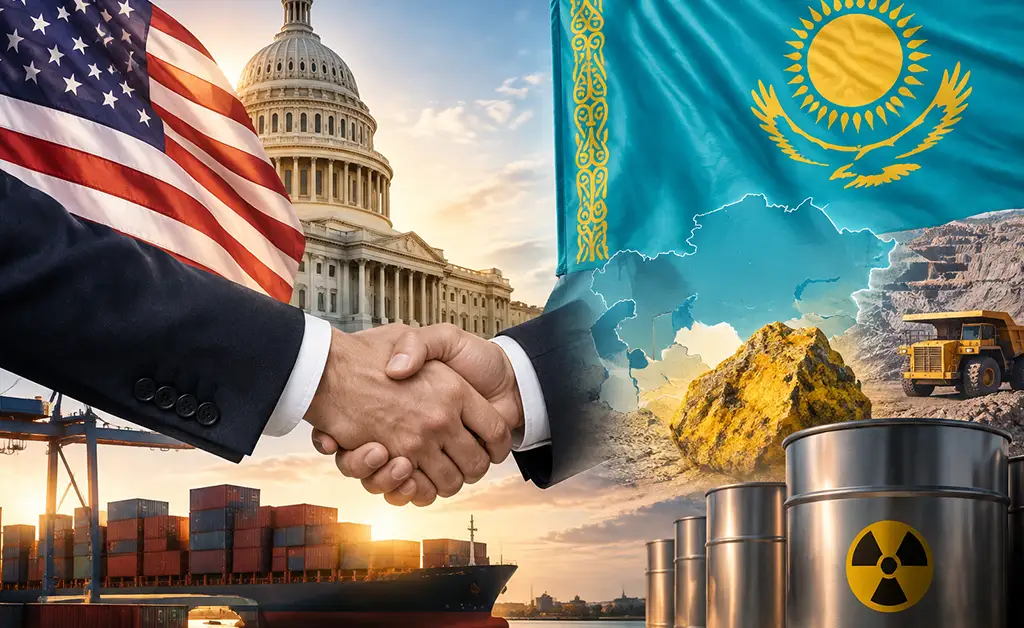
On 2 September, the US House of Representatives convened a hearing on critical minerals with Kazakhstan squarely at its centre. The witness list was unusually heavyweight for a regional session: John Herbst of the Atlantic Council, Daniel Runde and Gracelin Baskaran of the Center for Strategic and International Studies, and Morgan Bazilian of the Colorado School of Mines.
All four arrived at the same recommendation. The statutory framework still governing American trade with Kazakhstan, Uzbekistan and Tajikistan is a relic of a country that no longer exists, and it should be retired. Specifically, the witnesses urged Congress to lift Jackson-Vanik restrictions on the three republics and grant them permanent normal trade relations, or PNTR.
The numbers doing the persuading
The testimony leaned on a pair of figures that are hard to argue with. Kazakhstan supplies more than 25 per cent of American uranium imports — a dependency that already exists, priced and contracted, whatever the statute book says. Against that, the United States captures only 2.1 per cent of Central Asia’s mineral exports.
That asymmetry is the entire case. American reactors already rely on Kazakh supply, yet American firms are marginal players in the region’s wider minerals economy, where Chinese and Russian counterparts have spent two decades building offtake relationships, processing capacity and rail logistics. The witnesses framed Jackson-Vanik less as a barrier to imports than as a signal problem: a legal reminder, renewed annually, that Washington regards these markets as provisional.
What Jackson-Vanik still does in practice
Enacted in 1974 to tie trade benefits to emigration rights in the Soviet bloc, the Jackson-Vanik amendment denies unconditional normal trade relations to covered countries. Kazakhstan has been certified compliant for years, and goods move. The problem is the architecture rather than the tariff line.
Because the status is conditional and subject to periodic review, it introduces a variable that credit committees, insurers and long-cycle project sponsors are obliged to price. A ten-year offtake agreement or a capital equipment sale with a seven-year repayment tail is not underwritten on this year’s certification alone. It is underwritten on the assumption that nothing structural changes — and a statute requiring annual reaffirmation is, by definition, structural uncertainty.
Why exporters, lenders and brokers should be paying attention
PNTR would convert that conditional arrangement into a permanent one, and the practical effects would be felt in three places.
First, tariff predictability. Exporters and their customs brokers would be working from a schedule that no longer carries a political review clause, which simplifies multi-year pricing on industrial equipment, agricultural machinery and mining consumables.
Second, financing. The Export-Import Bank of the United States and the International Development Finance Corporation both weigh country risk when structuring cover. Removing a Cold War designation does not by itself change a risk rating, but it removes a documented reservation that appears in every underwriting memorandum. Private lenders take the same cue.
Third, insurance and compliance overhead. Political risk cover for Central Asian transactions is priced partly on legal status. A permanent designation is a cheaper one to insure than a renewable one.
For mid-market American exporters in particular — firms without in-house sovereign risk teams — these are not abstractions. They are the difference between a deal that clears an internal approval committee and one that does not.
H.R.1024 and the legislative path
The vehicle already exists. The US-Kazakhstan Trade Modernization Act, filed as H.R.1024, would deliver precisely what the witnesses described. Until this month it had attracted limited attention. A hearing in which four experts independently endorsed its central premise is the strongest signal yet that the bill has a constituency beyond its sponsors.
What to watch
Three markers will indicate whether the 2 September session was a turning point or a well-attended seminar. Watch for new co-sponsors on H.R.1024 in the weeks following the recess. Watch for whether Uzbekistan and Tajikistan remain bundled with Kazakhstan in any moving text, since the regional case is stronger than the bilateral one. And watch the Senate, where a companion measure would be needed for anything to reach the President’s desk.
For exporters, the near-term action is preparatory rather than reactive. Firms with existing or planned Kazakh business should be mapping which of their product lines would benefit from a permanent tariff schedule, and raising the question with their EXIM contacts now — before the statutory position changes rather than after.
