
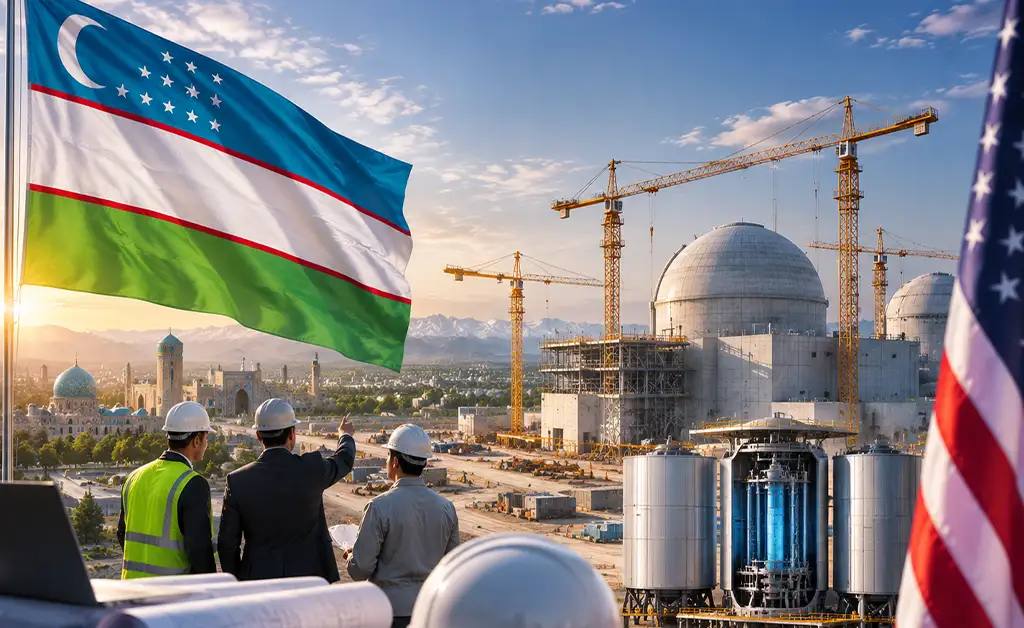
The absence that made the news
When President Shavkat Mirziyoyev set out the state of Uzbekistan’s nuclear power programme on 2 September, Rosatom — the Russian state corporation that has been the project’s presumed builder — did not appear in the statement.
In its place came the announcement of a new consortium of ‘leading international engineering companies’ that will supervise construction and carry out independent assessment. In a programme where the reactor technology itself is Russian, introducing external supervisory and assessment partners is a substantive reallocation of roles rather than a procedural footnote.
The project remains large. It comprises two 1 GW VVER-1000 reactors and two 55 MW RITM-200N units, at an estimated cost of $9.5 billion.
Reading the diplomatic timing
The announcement did not occur in isolation. In the same month, Mirziyoyev met US Senator Steve Daines and White House representative Sergio Gor. The current American administration has shown particular interest in small modular reactor cooperation across the region.
That combination — a Russian partner losing narrative prominence, an international supervisory consortium appearing, and senior American visitors arriving — is the sort of sequence that tends to precede a rebalancing of supplier relationships rather than a wholesale replacement.
It would be a misreading to conclude that Uzbekistan is cancelling Rosatom. The VVER-1000 and RITM-200N designs are Russian, and reactor technology decisions of that magnitude are not quietly reversed. What appears to be happening is the unbundling of a project that was previously integrated: technology from one source, supervision and assessment from another, and potentially future capacity from a third.
Where the American opening actually sits
For American nuclear suppliers, the realistic opportunity is not the reactor island. It is everything around it.
Engineering, procurement and construction management is the most immediate category, and it is precisely what the new consortium describes. Independent safety assessment and regulatory advisory work follows the same logic. So do instrumentation and control systems, turbine-side equipment, grid integration, and the long tail of qualified components that a nuclear programme consumes for decades after commissioning.
The second and larger opening is the small modular reactor question. Uzbekistan’s inclusion of two 55 MW units in its current programme establishes that the country intends to operate small reactors, not merely large ones. Once a regulator has built the framework for licensing small units, the marginal cost of licensing a second small design falls considerably. American SMR developers looking for early international deployments have an unusually receptive regulatory environment forming here.
The third category is fuel cycle services and workforce training — less visible, longer-dated, and historically where supplier relationships in nuclear energy are actually cemented.
The constraints worth stating plainly
Three factors temper the optimism. Russian reactor technology creates dependencies in fuel supply and technical support that persist for the operating life of the plant. Uzbekistan’s regulatory apparatus for nuclear energy is new and will take years to mature to the standard American exporters are accustomed to working within. And financing a $9.5 billion programme in a country of Uzbekistan’s fiscal profile requires sovereign or development finance structures that have not yet been publicly detailed.
None of these is disqualifying. All of them shape the pace at which any American participation could realistically develop.
The wider Uzbek picture
The nuclear announcement lands against a strengthening macroeconomic backdrop. Annual inflation fell to 6.2 per cent in August 2026. Bank deposits rose 34 per cent to reach 482 trillion som, and mortgage subsidies reached 1.14 trillion som. Textile production reached a value of 61.1 trillion som.
A deepening banking system and disinflation matter for infrastructure of this scale, because they determine whether domestic co-financing is available at tolerable cost. They also support the broader case Uzbekistan is making to American portfolio and direct investors.
What to watch
The consortium’s membership, when named, will be the single most informative disclosure. Watch also for any American company appearing in supervisory or assessment roles; for movement on SMR-specific cooperation following the Daines and Gor meetings; and for how the financing package is structured, since that will determine which suppliers are eligible to bid at all.
For American nuclear supply chain firms, the practical step is early positioning with the engineering consortium rather than direct approaches to Tashkent. In unbundled projects, the supervising engineer shapes the qualified vendor list long before procurement opens.
