
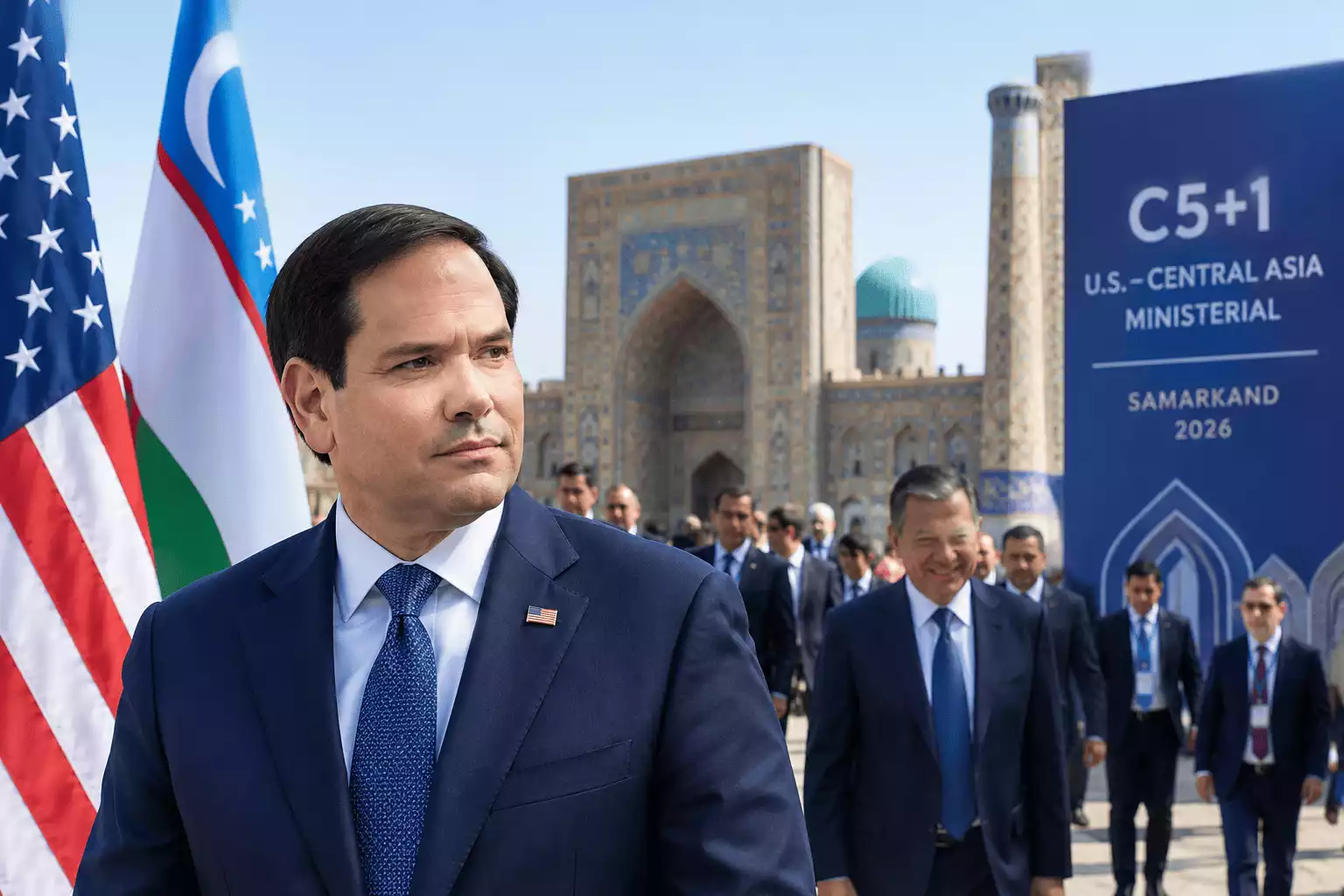
The future of US–Uzbekistan trade and investment is gaining fresh momentum following US Secretary of State Marco Rubio’s visit to Samarkand, where American officials and business leaders met their Central Asian counterparts to discuss commercial cooperation, investment opportunities and regional development. The visit places Uzbekistan at the centre of Washington’s efforts to strengthen economic ties with one of the world’s strategically positioned regions.
Arriving in Samarkand in October 2026, Rubio led a major American business delegation and participated in the C5+1 ministerial meeting, bringing together the United States and five Central Asian countries: Kazakhstan, Kyrgyzstan, Tajikistan, Turkmenistan and Uzbekistan. The programme also included discussions through the US–Uzbekistan Business and Investment Council, with the participation of Uzbek President Shavkat Mirziyoyev.
C5+1 Diplomacy Moves Towards Commercial Cooperation
The C5+1 format provides a platform for the United States and Central Asian governments to discuss shared priorities. While diplomatic dialogue remains important, the growing emphasis on trade, investment, energy and technology demonstrates the region’s potential as a destination for international business.
For American companies, Central Asia offers opportunities to explore new markets, develop commercial partnerships and participate in projects linked to natural resources, infrastructure and digital transformation. For regional economies, stronger engagement with US businesses can provide additional sources of capital, technology and international expertise.
The Samarkand meetings were therefore significant not simply because of the officials involved, but because they created opportunities for government representatives and businesses to discuss practical areas of cooperation.
According to the Uzbek government’s account of the business programme, participants represented a broad range of industries, including digital technologies, education, healthcare, mineral resources, energy, transport infrastructure, agriculture, textiles and finance. Business-to-business and business-to-government meetings were also planned to help turn discussions into potential investment projects.

US–Uzbekistan Trade and Investment: The Economic Opportunity
Existing trade figures illustrate the commercial potential of the wider region. In 2025, US trade in goods and services reached approximately $7.1 billion with Kazakhstan and $1.7 billion with Uzbekistan. These figures provide a useful indication of the existing relationship, while also highlighting the scope for further expansion.
Uzbekistan’s position is particularly important because of its population, economic ambitions and location within Central Asia. Its connections with neighbouring markets create opportunities for businesses seeking to establish a regional presence rather than operate in a single national market.
Potential areas of cooperation include industrial development, energy, mining, agricultural technology, financial services and digital infrastructure. American firms can contribute technical expertise and investment, while Uzbek partners can offer local market knowledge, established networks and access to regional opportunities.
However, commercial potential alone does not guarantee successful investment. Businesses must assess regulatory requirements, project economics, local partnerships, infrastructure and the time needed to bring projects into operation.
For this reason, institutional cooperation and clear investment procedures will be important in determining whether the renewed interest translates into lasting economic activity.
The Business and Investment Council’s Role
The US–Uzbekistan Business and Investment Council provides a mechanism for discussing commercial priorities and addressing barriers to cooperation. Its value lies in bringing public institutions and private-sector representatives into direct dialogue.
At the October meeting, the Uzbek government announced a package of 54 agreements and promising initiatives valued at approximately $12 billion. The announcement reflects the scale of the ambitions discussed, although the value of an announced project package should not automatically be interpreted as completed investment or money already spent.
The next stage will involve translating commitments into implementation plans, financing arrangements, commercial contracts and operational projects. Businesses will also need clear information about responsibilities, delivery schedules and the practical conditions attached to each agreement.
Why Samarkand Matters for Regional Trade
Samarkand has historically been associated with the movement of goods, people and ideas between different parts of Eurasia. Its modern economic significance reflects Central Asia’s continuing role in connecting markets across Europe and Asia.
For companies evaluating the region, the opportunity extends beyond bilateral trade. Partnerships established in Uzbekistan may support wider commercial activity across Central Asia, particularly where transport links, supply chains and industrial cooperation can be developed effectively.
Nevertheless, regional markets have different legal frameworks, infrastructure conditions and business requirements. Companies should approach expansion with a country-specific strategy rather than assume that a single agreement provides automatic access to every market.
Turning Diplomatic Momentum into Long-Term Growth
Rubio’s visit highlights a renewed effort to strengthen US commercial engagement with Central Asia. The meetings in Samarkand have brought trade, investment and technology into sharper focus, while providing a platform for businesses to explore new partnerships.
The lasting impact will depend on what follows: investment that reaches implementation, partnerships that create commercial value and projects that deliver measurable economic benefits.
For companies monitoring US–Uzbekistan trade and investment, the key development is not simply increased diplomatic attention. It is the possibility of converting that attention into sustainable business relationships across Uzbekistan and the wider Central Asian region.
