
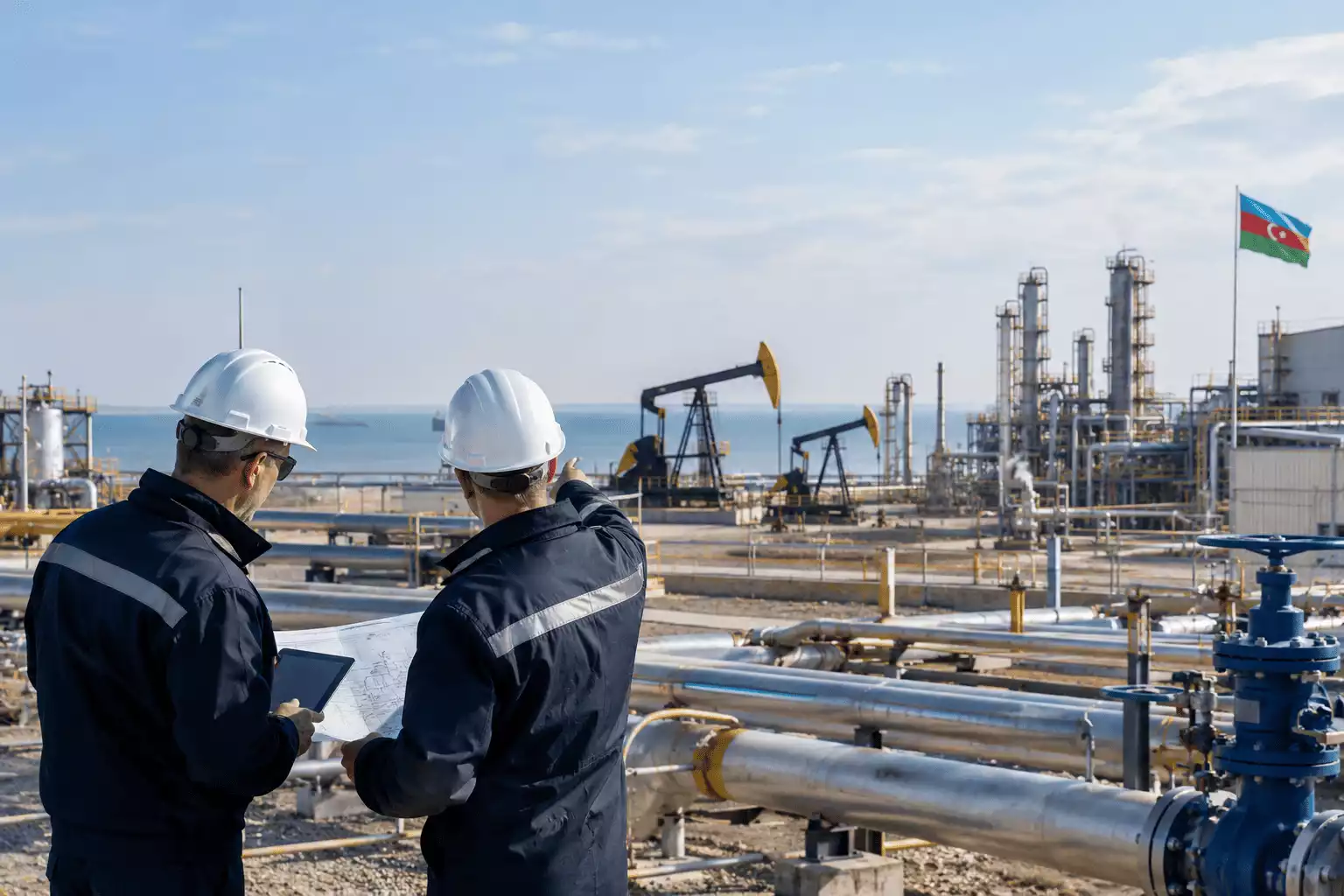
US energy investment in Azerbaijan is gaining momentum as international energy companies pursue new exploration and production opportunities in the Caspian region. Two developments involving ExxonMobil and Gran Tierra Energy have highlighted Azerbaijan’s continued importance to international energy businesses and its ambitions to attract foreign investment.
In September 2026, ExxonMobil and Azerbaijan’s State Oil Company, SOCAR, signed a production-sharing agreement covering unconventional hydrocarbon resources in the Middle Kura basin. Separately, Azerbaijan’s parliament ratified an exploration, development and production-sharing agreement involving US-listed Gran Tierra Energy for the Guba-Khazaryani area. Together, these developments demonstrate the range of opportunities being explored within Azerbaijan’s energy sector. [1][2]
ExxonMobil and SOCAR Establish a Partnership in the Middle Kura Basin
The agreement between ExxonMobil and SOCAR establishes a 50:50 partnership for exploring, developing and producing unconventional hydrocarbon resources in the Middle Kura basin.
ExxonMobil will serve as the project’s operator, giving the US energy company responsibility for managing the relevant operational activities under the agreement. SOCAR’s participation provides a local industry partner with established knowledge of Azerbaijan’s energy sector.
Production-sharing agreements are commonly used in oil and gas exploration because they establish how participating companies share responsibilities, risks and potential production. However, signing an agreement does not establish that commercially recoverable resources have been confirmed or that production will begin immediately.
Exploration and development projects can require substantial technical work, investment and time before their commercial viability becomes clear. Geological assessments, drilling results, infrastructure requirements and prevailing market conditions will all influence future decisions.
For ExxonMobil, the agreement provides a framework for evaluating unconventional hydrocarbon potential in Azerbaijan. For SOCAR, cooperation with an international energy company offers an opportunity to combine domestic expertise with additional technical and operational capabilities.
Gran Tierra Energy Expands Its Azerbaijan Exploration Interests

A second development concerns Gran Tierra Energy, an international oil and gas company listed on the NYSE American exchange.
Azerbaijan’s parliament ratified the company’s exploration, development and production-sharing agreement for the Guba-Khazaryani region. Gran Tierra holds a 65% working interest in the project, according to the original announcement supplied for this report. [2]
The agreement covers an onshore exploration area in northern Azerbaijan. Its significance lies in the potential to evaluate resources outside the country’s established offshore production areas, although the project’s eventual contribution will depend on exploration results and subsequent investment decisions.
Onshore exploration can present different operational conditions from offshore development. Access to land, existing infrastructure, geological characteristics and the location of potential reserves can all affect costs and project planning.
For Azerbaijan, attracting companies willing to undertake exploration work can help broaden participation in its energy industry. For investors, the opportunity must be assessed against geological uncertainty, contractual obligations, capital requirements and the possibility that exploration may not result in commercially viable production.
These factors make it important to distinguish between an exploration agreement and a producing asset. The former creates a framework for investigating potential resources; it does not, by itself, guarantee future output or revenue.
More Than $10 Billion in Potential Investment Agreements
The two energy developments came amid a broader investment drive in Azerbaijan.
At an international investment forum in Baku in September 2026, Azerbaijan announced agreements representing more than $10 billion in potential investment. The package included major energy-related developments alongside the wider effort to attract international capital. [3]
This wider investment context matters because large energy projects depend on more than the availability of underground resources. They may also require supporting infrastructure, engineering services, financing, logistics and long-term commercial arrangements.
International investment can help mobilise these capabilities, while local companies can contribute workforce expertise, established operating relationships and knowledge of the domestic business environment.
Nevertheless, the headline value of an investment announcement should not be treated as equivalent to money already invested. Individual projects can move through several stages, from initial agreement and feasibility assessment to financing, construction and commercial operation.
The pace of progress will therefore be an important indicator of whether Azerbaijan’s investment ambitions translate into measurable economic activity.
Azerbaijan’s Position in the Caspian Energy Market
Azerbaijan occupies a strategic position between Central Asia, the South Caucasus and European markets. Its established oil and gas industry, export connections and location along the Caspian Sea contribute to its importance in regional energy discussions.
The country’s wider economic strategy also creates an incentive to attract international partners capable of supporting industrial development and technical modernisation.
For American companies, the opportunity extends beyond securing access to prospective hydrocarbon resources. Long-term partnerships can establish relationships with local suppliers, service providers and institutions, potentially creating opportunities across related parts of the energy value chain.
At the same time, energy markets remain exposed to price movements, regulatory changes, financing conditions and evolving demand. Investors must consider these risks alongside the potential commercial benefits.
What the Developments Mean for Future Investment
The ExxonMobil–SOCAR agreement and Gran Tierra’s exploration project illustrate continued interest in Azerbaijan’s energy potential.
Both developments remain subject to the practical requirements of exploration and development. Their long-term significance will depend on technical results, project economics and the ability to progress towards commercially viable operations.
For businesses following US energy investment in Azerbaijan, the key issue is whether these agreements lead to sustained exploration, productive partnerships and additional investment across the sector.
The latest developments strengthen the framework for international cooperation. Their ultimate economic value, however, will be determined by what companies discover, develop and successfully bring to market.
