
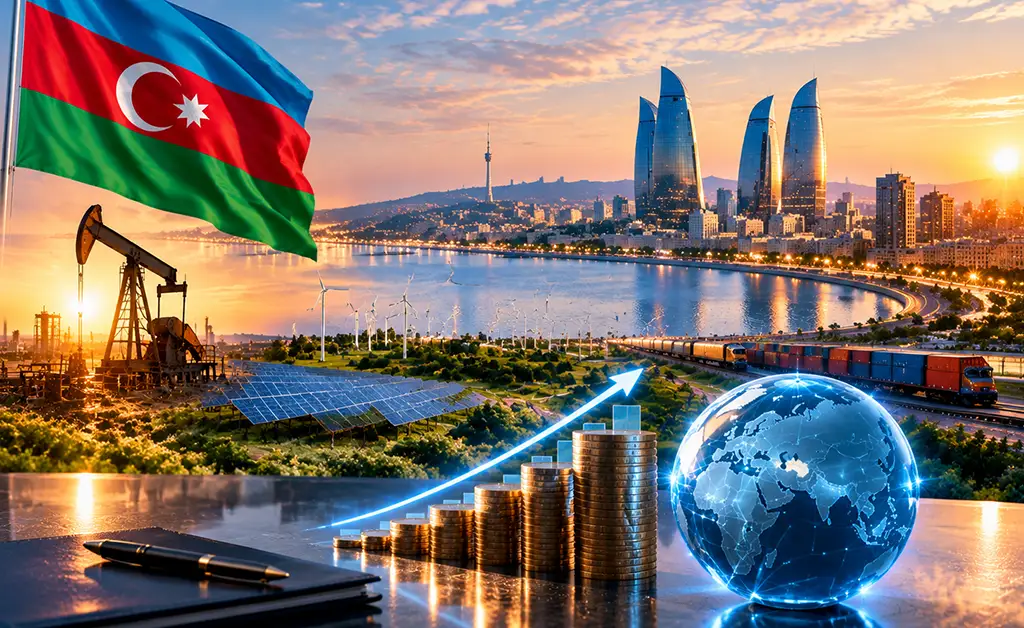
BAKU — Latest macroeconomic performance indicators released by the State Statistics Committee of Azerbaijan on 11 September 2026 reveal a stark divergence between total capital deployment and non-energy sector expansion. Total fixed capital investment across the economy expanded by 10 per cent year-on-year during the first eight months of 2026, exceeding 12.6 billion manats, equivalent to approximately 7.4 billion US dollars. This robust headline capital accumulation demonstrates sustained domestic and international commitment to large scale asset build-out.
However, detailed sectoral breakdowns highlight structural economic friction. Fixed capital allocated specifically to the non-oil and gas sector reached 8.4 billion manats, or roughly 4.9 billion dollars, during the January to August period. Despite representing the larger share of nominal capital allocation, capital expenditure in non-oil segments registered a sluggish growth rate of merely 1.4 per cent compared to the corresponding period in 2025. This noticeable deceleration in capital uptake across non-extractive industries underscores the ongoing challenge of translating heavy infrastructure expenditure into broad based economic momentum. Addressing this structural bottleneck remains the core priority for policymakers seeking to diversify azerbaijan non oil sector investment 2026 outcomes.Central Bank Downgrades Macroeconomic Growth Trajectory
Reflecting the muted performance of non-extractive sectors, Central Bank Governor Taleh Kazimov confirmed revised macroeconomic growth projections for the current and upcoming fiscal years. The central bank has adjusted its real gross domestic product growth forecast for 2026 downward to 0.5 per cent, with non-oil sector growth expected to reach 2.4 per cent. Looking ahead to 2027, overall economic growth is projected to recover modestly to 2.6 per cent.
The revised trajectory highlights how heavily national output remains influenced by hydrocarbon extraction cycles and global commodity pricing, despite extensive state led diversification programs. While state backed capital projects in transportation corridors and renewable energy installations continue at pace, private sector credit absorption and private enterprise capital expenditure in light manufacturing, services, and agriculture remain restrained. Central bank officials note that monetary policy settings will focus on maintaining price stability and supporting liquidity conditions necessary to stimulate private business expansion without stoking inflationary pressures.Upcoming Baku Investment Forum Focuses on Regional Connectivity
In response to these growth challenges, the Ministry of Economy and the Azerbaijan Export and Investment Promotion Agency, in collaboration with The European House Ambrosetti, will host the second Azerbaijan International Investment Forum in Baku on 25 and 26 September 2026. Operating under the theme of rebuilding trust in a fragmented world, the forum aims to position the South Caucasus region as an anchor of global supply chain connectivity and long term investment stability.
The forum agenda focuses directly on high value non-oil sector opportunities, including Middle Corridor transit logistics, green energy transitions, artificial intelligence adoption, critical raw materials processing, and small business financing frameworks. Attracting international capital to these specific verticals is seen as essential for revitalising non-energy industrial output. Key multilateral financial institutions are stepping up participation ahead of the gathering. On 9 September 2026, the Asian Infrastructure Investment Bank confirmed it is formulating a comprehensive multi-year investment program with Azerbaijani authorities, focusing on sustainable transport infrastructure and renewable power integration. The azerbaijan international investment forum baku 2026 will serve as a primary benchmark for measuring foreign institutional interest in these non-extractive initiatives.Strategic Entry Points for Foreign Capital Diversification
For foreign corporate investors and private equity funds, current economic conditions create strategic entry points across free economic zones and specialized industrial parks. Government incentives, tax exemptions, and streamlined administrative procedures within designated economic zones are structured to lower operational entry costs for export oriented businesses.
However, realizing full economic return requires navigating ongoing structural adjustments within domestic financial markets. By aligning international private capital with state backed transport corridor projects and regional green energy networks, corporate investors can participate in high impact regional connectivity ventures. Foreign firms evaluating prospective capital deployment can assess detailed risk profiles and regulatory frameworks when investing in azerbaijan non oil economy assets during the upcoming international investment summit.
