
Key Takeaways
- Middle Corridor container traffic reached 53,574 TEU in January to August 2026, up 11% from 48,326 TEU a year earlier, according to ADY Express, yet the empty container problem persists.
- Westbound shipments totaled 42,642 TEU and eastbound only 10,932 TEU, a split of roughly 80% to 20%.
- Empty containers returning east raise repositioning costs, so operators are seeking eastbound cargo such as refrigerators and automotive products.
- In February 2026 the World Bank approved an $846 million guarantee to mobilize $1.41 billion for a Kazakh railway project on the corridor.
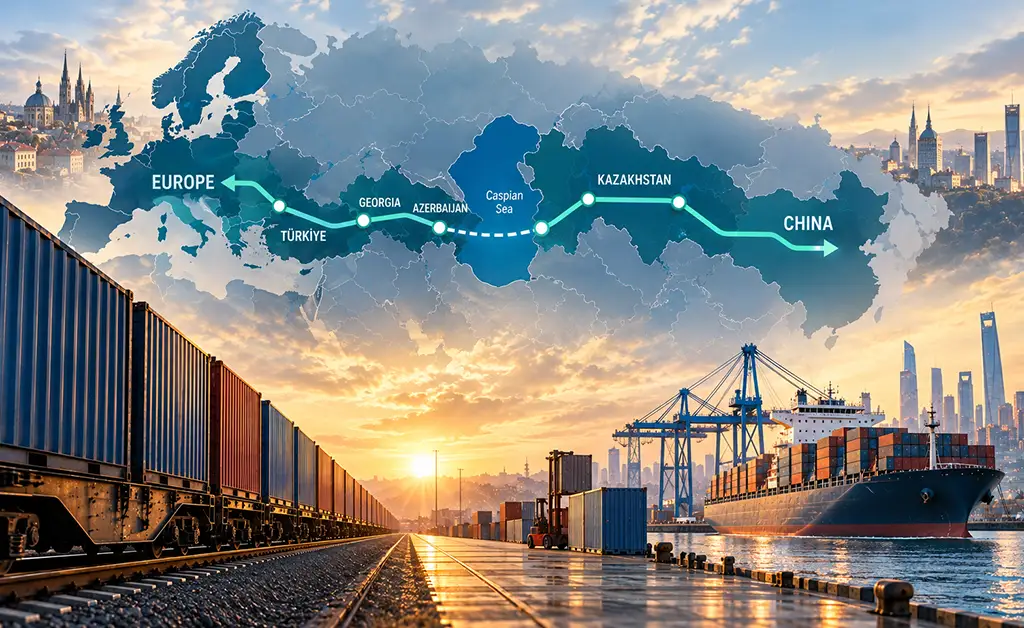
AZERBAIJAN — Operational figures covering the first eight months of 2026 demonstrate continued quantitative expansion along the Trans-Caspian International Transport Route, widely known as the Middle Corridor. Data released on 9 September 2026 indicates that freight traffic across the corridor reached 53,574 twenty-foot equivalent units between January and August, representing an 11 per cent increase compared to 48,326 units moved during the same period in 2025. A total of 265 container block trains were successfully dispatched across the multi-modal network during this timeframe.
In This Article
What Is the Middle Corridor’s Empty Container Problem?
Despite encouraging volume growth, detailed operational metrics highlight a severe structural imbalance in freight distribution. Westbound cargo moving from East Asia toward European markets accounted for 80 per cent of total corridor throughput, totaling 42,642 container units. In stark contrast, eastbound traffic moving from Europe toward Central Asia and China comprised only 20 per cent of total volume, amounting to just 10,932 units. This acute four-to-one operational asymmetry forces logistics operators to reposition thousands of empty containers back to eastern origin points at significant financial expense. Resolving the Middle Corridor’s eastbound cargo imbalance has consequently emerged as the primary operational imperative for corridor member states and commercial railway operators.
Middle Corridor Container Traffic, January to August 2026
| Measure | TEU | Share |
|---|---|---|
| Total | 53,574 | 100% |
| Westbound (east to west) | 42,642 | About 80% |
| Eastbound (west to east) | 10,932 | About 20% |
| Same period 2025 | 48,326 | Growth: +11% |
How Does the Imbalance Affect Trans-Caspian Freight Rates?
The severe directional imbalance directly impacts corridor profitability, asset utilization, and commercial pricing structures. Multi-modal transit across the Caspian Sea requires coordinated vessel sailings, port handling, and rail transfers across multiple national jurisdictions. When vessels and rail flatcars return eastward carrying empty containers, overall operating margins decline, placing upward pressure on westbound freight rates.
Logistics advisors at Azerbaijan Railways have emphasized that attracting consistent European export cargo is essential to optimize route economics and lower unit costs. Commercial breakthroughs demonstrate potential solutions. In May 2026, a specialized block train dispatched 50 forty-foot containers loaded with commercial refrigerators from Turkey directly to China, demonstrating that manufactured consumer goods and industrial machinery can effectively utilize eastbound return capacity. For European and American exporters shipping goods into Central Asia, empty container availability creates favorable bargaining leverage to negotiate competitive transport rates. Tracking Trans-Caspian container rates through 2026 provides valuable commercial insight for international supply chain planners.
How Are Lenders Responding to Middle Corridor Bottlenecks?
Multilateral financial institutions are committing substantial capital resources to eliminate logistical bottlenecks and improve corridor efficiency. In February 2026, the World Bank approved an $846 million guarantee intended to mobilize $1.41 billion for a Kazakh railway project along the corridor. This capital deployment is structured to modernize track infrastructure, expand port handling capacity, and digitize customs procedures along key rail bottlenecks.
The strategic objective of these multilateral investments is to triple overall corridor freight capacity by 2030 while reducing total transit times by half. Physical infrastructure upgrades include expanding container terminal capacity at Baku International Sea Trade Port and Aktau Port, alongside track duplication projects along regional rail networks. Digital integration platforms are also being implemented to standardize electronic freight documentation across national borders, reducing delay times at sea-to-rail transfer points. Long-term growth projections depend entirely on whether these structural upgrades can support growing Middle Corridor TEU volumes in 2026 while simultaneously balancing directional trade flows.
Regional Transit Realignment and Geopolitical Risk Factors
The evolution of the Middle Corridor takes place within a complex regional logistics landscape. Alternative transit routes across neighboring territories continue to emerge, introducing distinct regulatory and compliance considerations for global logistics providers. Between 11 and 13 September 2026, reports confirmed that the initial China-Iran block train carrying 55 containers departed Xinjiang on 7 September, routing through Kazakhstan, Uzbekistan, and Turkmenistan toward its Iranian destination.
Industry analysts note that alternative transit corridors passing through sanctioned jurisdictions present heightened compliance scrutiny for international freight forwarders and Western logistics firms. Consequently, the Middle Corridor remains the preferred sanctions-compliant trade route connecting East Asia with Eastern Europe. As corridor management entities work to attract European manufactured exports to balance westbound container flows, the route’s commercial viability and competitive positioning will depend on achieving operational equilibrium across both transit directions.
What This Means for Turkish American and Turkic Businesses
For US and Turkish exporters shipping machinery, consumer durables or components to Central Asia and China, the eastbound imbalance is a negotiating point: carriers need return cargo. Ask forwarders for eastbound Middle Corridor quotes and compare total landed cost with sea and Northern Corridor options.
Turkish American logistics firms can aggregate eastbound loads from Türkiye, building on examples such as the May 2026 Izmir-to-China refrigerator train run by KTZ Express and Pasifik Eurasia. Check sanctions exposure carefully on any routing that touches Iran.
Frequently Asked Questions
How much cargo moved on the Middle Corridor in 2026?
Container traffic on the Middle Corridor reached 53,574 TEU in January to August 2026, up 11% from 48,326 TEU in the same period of 2025, according to ADY Express, a subsidiary of Azerbaijan Railways. A total of 265 container block trains operated in the period.
Why is eastbound cargo a problem on the Middle Corridor?
Only about 20% of Middle Corridor containers moved eastbound in January to August 2026. Containers that return empty to Central Asia and China add repositioning costs, which push up westbound rates. Operators want more European, Turkish and other exports moving east.
What eastbound cargo is moving on the Middle Corridor?
Examples include a May 2026 train from Izmir to China carrying household refrigerators in fifty 40-foot containers, run by KTZ Express and Pasifik Eurasia. Azerbaijan Railways has also named automotive products as possible eastbound cargo, but such shipments remain limited.
Sources
- Report.az, Middle Corridor Freight Traffic Rises 11% in January-August, September 9, 2026. Accessed November 16, 2026.
- The Times of Central Asia, Middle Corridor Freight Grows, but Eastbound Cargo Lags, September 10, 2026. Accessed November 16, 2026.
Related Coverage
- The Middle Corridor’s Backhaul Gap: An Opening for US Exporters to Central Asia
- Inside the World Bank’s $55 Billion Trans-Caspian Blueprint: What It Means for US Exporters
- Azerbaijan as a Regional Base: The $201 Million Trans-Caspian Fund and What the USACC Playbook Signals
About the American-Turkic Republics Business Alliance (ATBA)
The American-Turkic Republics Business Alliance (ATBA) is a New York-based nonprofit platform that strengthens trade, investment and business collaboration between the United States and the Turkic republics: Türkiye, Azerbaijan, Kazakhstan, Uzbekistan, Kyrgyzstan and Turkmenistan. Companies and professionals can join the network through ATBA membership.
