
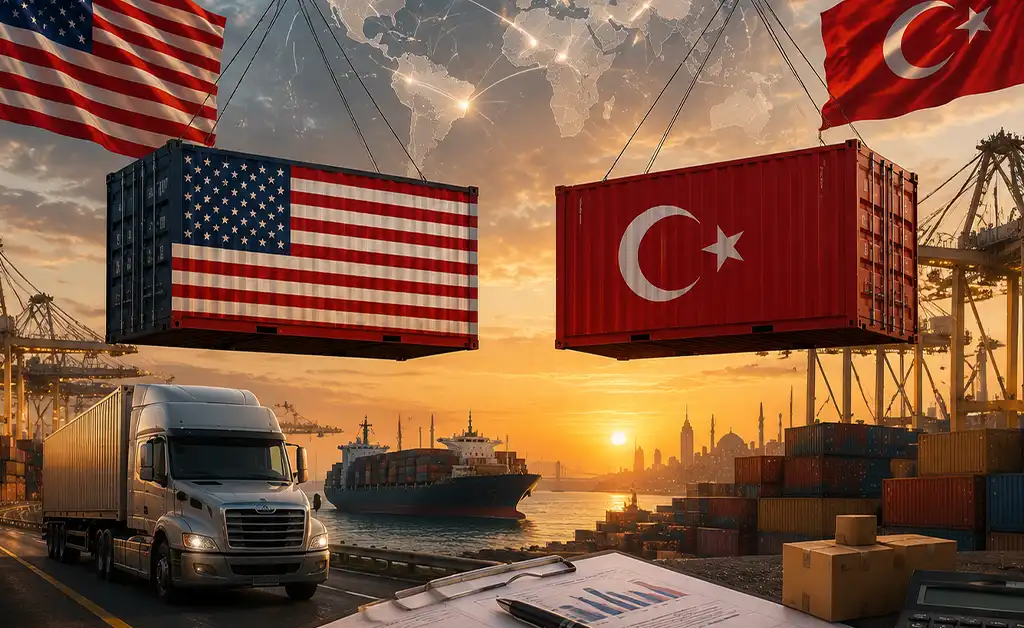
Since 24 July 2026 most Türkiye-origin goods carry an extra 12.5% at the U.S. border. Kazakhstan carries exactly the same. Azerbaijan, Uzbekistan, Kyrgyzstan and Turkmenistan carry none at all. Here is what to verify before the next purchase order goes out.
What actually changed on 24 July
The Office of the U.S. Trade Representative closed 60 Section 301 investigations into whether trading partners prohibit and enforce a ban on imports made with forced labour. Every one of the 60 was found actionable. The remedy is an additional ad valorem duty, applied in two tiers: 10% for economies that already have a prohibition in place or have given a reciprocal-trade commitment, and 12.5% for everyone else. Seventeen economies drew the lower rate. Türkiye drew the higher one.
The timing matters as much as the rate. The duty took effect at 12:01 a.m. Eastern on 24 July 2026 — the exact moment the temporary 10% global surcharge under Section 122 lapsed by operation of law after its 150-day statutory limit. For an importer, that produces two very different arithmetic outcomes depending on origin:
- Türkiye and Kazakhstan: 10% → 12.5%. A 2.5-point increase, and the surcharge is now permanent-in-nature rather than time-limited.
- Azerbaijan, Uzbekistan, Kyrgyzstan, Turkmenistan: 10% → 0%. These economies were never among the 60 investigated, so the lapse of Section 122 left nothing behind it.
In other words, the effective gap between Türkiye and its Central Asian and Caucasus neighbours did not widen by 2.5 points on 24 July. It widened by 12.5.
The Turkic map of U.S. tariff exposure
Because the question comes up in almost every sourcing conversation we have had since July, here is the whole picture in one place — the six Turkic-speaking states, side by side.
| Origin | Sec. 301 forced-labour duty | Trade-relations status | Practical note |
| Türkiye | 12.5% | NTR / MFN, no FTA | In the top tier. No qualifying import prohibition and no reciprocal-trade commitment on file. Excluded from the textile tariff-rate-quota mechanism. |
| Kazakhstan | 12.5% | Conditional NTR (Jackson-Vanik annual review) | The only other Turkic state inside the action, and at the same rate as Türkiye. WTO member since 2015. |
| Azerbaijan | None | Conditional NTR (Jackson-Vanik annual review) | Not among the 60 investigated economies. MFN rates only. WTO accession still in progress. |
| Uzbekistan | None | Conditional NTR (Jackson-Vanik annual review) | Outside the action, and the subject of a June 2026 “early harvest” trade package with Washington. |
| Kyrgyzstan | None | PNTR (granted 2000) | Outside the action. The only Turkic state in the group with permanent normal trade relations. |
| Turkmenistan | None | Conditional NTR (Jackson-Vanik annual review) | Outside the action. Very thin U.S.-bound export base; WTO accession begun in 2022. |
Section 301 forced-labour duty as applied from 24 July 2026. The rate shown is the additional overlay only — ordinary MFN duty, Section 232 duties and any AD/CVD orders apply separately.
One warning about that table. A zero in the second column is not a zero at the border. It means no Section 301 forced-labour overlay. The ordinary HTS general rate still applies, Section 232 duties on covered steel, aluminium, copper and automotive products still apply, and antidumping or countervailing orders still apply where they reach the goods.
The checklist: nine things to confirm before the order
1. Classify to ten digits before you price anything
The overlay is applied by HTS subheading, not by a blanket country rate. A supplier quoting “12.5% on everything from Türkiye” is guessing. Two products in the same container can land differently.
2. Check the Annex A exclusions against your codes
The Federal Register notice carves out thousands of subheadings. Broad exempt categories include oil and gas, fertiliser, aircraft and parts, critical minerals and a range of food products. Confirm code by code — do not assume category membership.
3. Test the Section 232 overlap
Goods already covered by a Section 232 action — steel, aluminium, copper, automobiles, and the medium and heavy truck, bus and parts actions — are excluded from the forced-labour overlay. For some Turkish exporters this is the difference between a 12.5-point hit and none. It is also the single most commonly missed exemption we see.
4. Do not plan around a textile quota that does not exist for Türkiye
A draft in June suggested tariff-rate quotas might let some apparel and textile volume in at a reduced or zero Section 301 rate. The final action named Bangladesh, Cambodia, Indonesia and Malaysia only. Turkish apparel, home textiles and carpets take the full 12.5%. Several buyers built Q4 costings on the draft. Rebuild them.
5. Nail down the entry date, not the order date
The duty attaches to goods entered for consumption, or withdrawn from warehouse for consumption, on or after the effective moment. The in-transit relief for cargo already loaded closed in late July, so it no longer helps anyone. What still matters is warehouse strategy and entry timing on goods you already control.
6. Read your Incoterms before you argue about who pays
On DDP terms the Turkish seller absorbs the increase; on FOB or EXW the U.S. buyer does. Most disputes we have been asked about since July are not customs disputes at all — they are contract disputes that a duty-change clause would have settled in advance. Add one to the next framework agreement.
7. Re-check bond sufficiency
A 12.5-point increase on a steady import programme can push a continuous bond under its required amount, which triggers a CBP insufficiency notice and, in the worst case, held cargo. Recalculate against projected twelve-month duties, not last year’s.
8. Substantiate origin properly
Moving final assembly to a neighbouring country does not move origin unless substantial transformation genuinely occurs there. Routing Turkish goods through Azerbaijan or Kazakhstan to reach a 0% overlay is not a sourcing strategy; it is a transshipment exposure with penalty consequences.
9. Keep the forced-labour import ban separate in your mind
This is the point most often confused. The Section 301 overlay is a tariff. The long-standing U.S. prohibition on importing goods made with forced labour is a different instrument entirely, it applies to every origin, and it results in detention and exclusion rather than a duty bill. An origin with a 0% overlay is not an origin with lower diligence obligations. Cotton and cotton-derived goods from Central Asia, in particular, still warrant full supply-chain documentation.
So should you re-source? Read the capacity numbers first
The tariff differential looks decisive on a spreadsheet. The export capacity behind it usually is not.
| Origin | Goods exported to the U.S. (2024) | What that means for a buyer |
| Türkiye | approx. $16.4 billion | Deep, diversified, U.S.-facing manufacturing base across machinery, textiles, jewellery, vehicles and parts. |
| Azerbaijan | approx. $158 million | Heavily energy-weighted. Little manufacturing capacity aimed at the U.S. retail market. |
| Uzbekistan | approx. $42 million | Real textile ambition and an improving trade relationship, but a very small U.S.-facing base today. |
| Kyrgyzstan | approx. $17 million | Marginal as a direct U.S. supply origin. |
| Turkmenistan | approx. $15 million | Marginal as a direct U.S. supply origin. |
Trade values are 2024 goods exports to the United States; Türkiye figure reflects 2025 USTR data.
Put bluntly: the four zero-overlay Turkic states together shipped the United States roughly one and a half per cent of what Türkiye shipped. A 12.5-point duty advantage on a supplier who cannot hold your volumes, meet your quality specification or hit your lead times is not an advantage. For most buyers the realistic response is not relocation but re-engineering the existing Turkish relationship — exemption analysis, classification review, duty-sharing, and where the product allows it, a Section 232 or Annex A path.
What to watch next
- Federal Register follow-ups clarifying scope and any new exclusions — the technical implementation detail is still settling.
- Any move by Ankara toward a qualifying forced-labour import prohibition, which is the stated criterion for the lower 10% tier.
- Any U.S.–Türkiye reciprocal trade instrument, the other route several economies used to reach 10%.
- The unresolved appellate litigation over the wider tariff architecture, which could change the baseline again.
- Whether Washington converts its “favourable consideration” language toward Uzbekistan into concrete tariff treatment, which would be the first real Central Asian preference in this cycle.
