
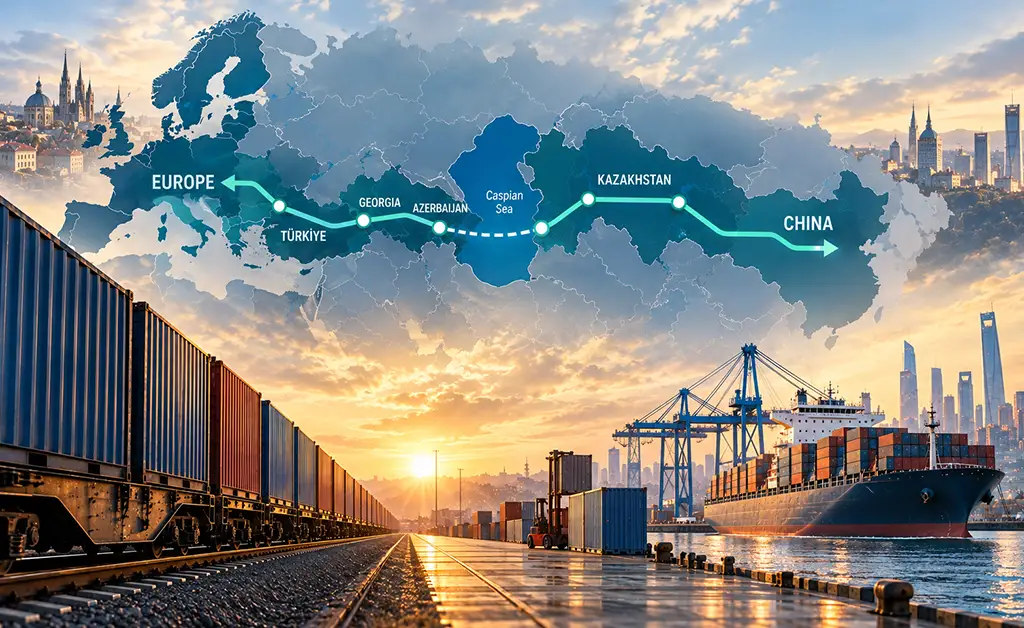
An imbalance most coverage misses
Reporting on the Middle Corridor has concentrated almost entirely on volume growth — more containers, more rail capacity, shorter transit times. Less attention has been paid to the direction those containers travel.
Approximately 80 per cent of container movements on the route are westbound, carrying goods from China and Central Asia towards Europe. The eastbound leg is comparatively empty.
For carriers and operators, that asymmetry is a persistent cost problem. Empty containers must be repositioned, and the expense of doing so is recovered through westbound rates. For shippers moving cargo in the other direction, the same imbalance produces the opposite effect.
Why this matters for American exporters
Carriers with capacity they would otherwise run empty have a structural incentive to price eastbound freight competitively. Any revenue on the return leg is better than repositioning at a loss.
This means exporters shipping from the United States or Europe into Kazakhstan, Uzbekistan and the wider region may find eastbound rates on the trans-Caspian route more favourable than volume-based logic would suggest. The route’s commercial economics are being shaped by the need to fill returning equipment rather than by demand on that leg.
The practical implication is that American exporters who have not examined Middle Corridor routing — perhaps assuming it to be a China-to-Europe corridor that does not concern them — may be leaving a cost advantage unexamined.
Which goods fit the route
Not every consignment suits trans-Caspian routing. The categories that fit best share three characteristics.
They are time-sensitive relative to sea freight but not urgent enough to justify air. The Middle Corridor’s core proposition is a transit time between the two, and goods that gain nothing from arriving faster than sea freight will not justify the premium that remains.
They are destined for landlocked markets. For cargo terminating in Central Asia rather than transiting onward, the route avoids the additional handling and inland haulage that sea routing to a regional port would require.
They are of sufficient value density to absorb multimodal handling. Every transfer between rail, Caspian shipping and road adds cost and handling risk. High-value industrial equipment, components, pharmaceuticals and specialist machinery absorb that better than bulk commodities do.
The constraints to verify before committing
Exporters should confirm four things before routing freight this way. Caspian ferry capacity and scheduling, which remains the route’s principal bottleneck and is subject to weather and vessel availability. Customs procedures at each border crossing, since the corridor traverses multiple jurisdictions with differing documentation requirements. Insurance terms, which should explicitly cover multimodal transfer points. And the availability of equipment in the right specification, since not every container type is repositioned in equal numbers.
These are operational questions with known answers, and any experienced freight forwarder active on the route can address them. They are, however, questions worth asking before the first consignment rather than during it.
A data point worth tracking
A World Bank assessment of the Middle Corridor scheduled for release on 27 September is expected to provide independent measurement of capacity, cost structure and bottlenecks along the route.
Institutional analysis of this kind matters for exporters because it establishes a shared reference point for negotiation. Freight rate discussions conducted against published capacity and cost data proceed differently from those conducted on carrier assertion alone.
What to watch
Three indicators will show whether the backhaul gap narrows or persists: whether eastbound volumes grow faster than westbound, which would erode the pricing advantage; whether Caspian shipping capacity expands sufficiently to remove the scheduling constraint; and whether carriers begin marketing eastbound services actively rather than treating them as repositioning revenue.
For now, the imbalance is real and the opportunity is available to exporters willing to ask for it. The firms that benefit will be those that approach carriers with specific eastbound volumes rather than those waiting for the rates to be advertised.
