
Key Takeaways
- US engagement with Central Asia has shifted toward critical minerals, industrial investment and logistics.
- DFC issued a letter of interest exploring up to $700 million for Kazakh tungsten and signed Heads of Terms with Uzbekistan in February 2026.
- Kazakhstan produces more than 40 percent of world uranium and supplied 24 percent of uranium delivered to US reactors in 2024, officials said.
- The World Bank approved an $846 million guarantee for a new Middle Corridor rail line in Kazakhstan.
The economic relationship between the United States and Central Asia is undergoing a major transformation. What was once considered a secondary diplomatic partnership is now rapidly evolving into a strategic economic alliance focused on critical minerals, industrial investment, logistics, and long-term supply chain security.
In This Article
By May 2026, the shift was visible in financing decisions, not just diplomatic statements.
American policymakers and private investors intensified their attention toward Kazakhstan and Uzbekistan, particularly in sectors linked to uranium, tungsten, lithium, copper, and rare earth elements. These resources are no longer viewed as ordinary commodities. They are now considered essential assets for the future of electric vehicles, artificial intelligence systems, semiconductor manufacturing, renewable energy infrastructure, and advanced defense technologies.
The growing economic cooperation reflects a broader reality: Central Asia is becoming one of the world’s most strategically important investment regions.
Why Are Critical Minerals at the Center of US-Central Asia Cooperation?
Critical minerals sit at the center. In February 2026, DFC issued a letter of interest exploring up to $700 million to help finance tungsten development in Kazakhstan, according to the State Department, and signed Heads of Terms with Uzbekistan for a joint investment framework that proposes a minerals holding company, according to DFC.
The United States has increasingly prioritized access to strategic raw materials that are necessary for modern industrial production. Central Asian nations, particularly Kazakhstan and Uzbekistan, possess enormous reserves of minerals that are vital for future technologies and manufacturing systems.
Kazakhstan produces more than 40 percent of the world’s uranium, according to the World Nuclear Association, and Kazakh officials say it supplied 24 percent of uranium delivered to US civilian reactors in 2024. Uzbekistan is also a significant uranium producer, and both countries are attracting attention for tungsten, copper, lithium and rare earth elements.
American institutions and private companies are now pursuing:
- long-term mining agreements,
- infrastructure partnerships,
- mineral processing facilities,
- and industrial technology investments.
This approach marks a clear transition from short-term trade discussions toward deeper industrial cooperation.
US Financing Signals in Central Asia, 2025-2026
| Instrument | Country | Detail |
|---|---|---|
| DFC letter of interest | Kazakhstan | Up to $700M for tungsten (non-binding) |
| DFC Heads of Terms | Uzbekistan | Joint investment framework; proposed holding company |
| World Bank IBRD guarantee | Kazakhstan | $846M guarantee mobilizing $1.41B for KTZ |
| Wabtec order | Kazakhstan | $4.2B locomotives and service |
How Is Kazakhstan Strengthening Its Economic Position?
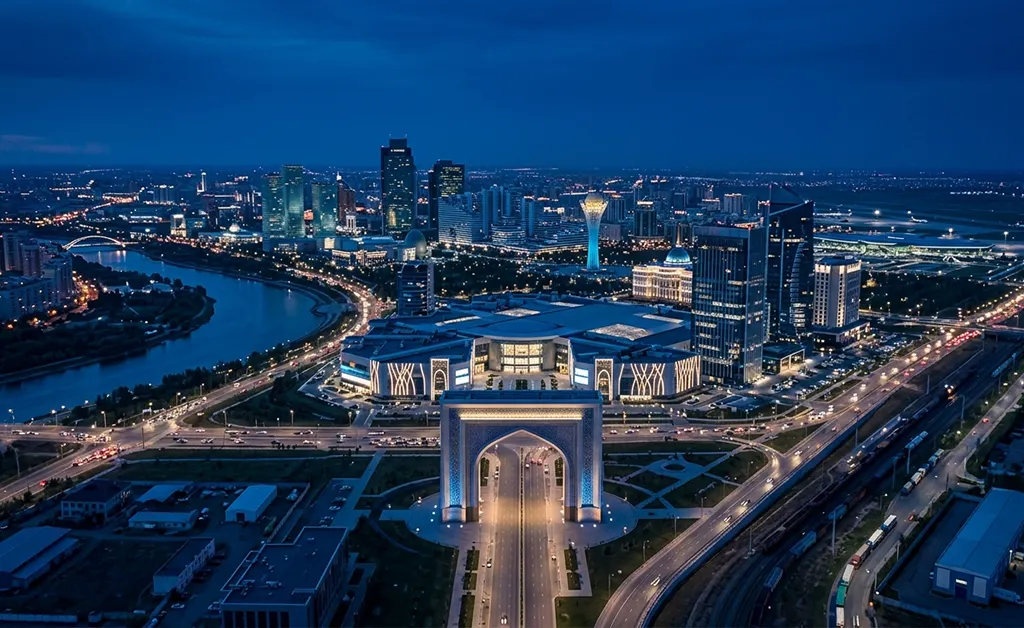
Kazakhstan has emerged as one of the most important economic partners for the United States in Central Asia.
US-backed activity in Kazakhstan’s tungsten sector has accelerated, from Cove Capital’s joint venture with state miner Tau-Ken Samruk to the DFC letter of interest. Tungsten is vital for aerospace, industrial machinery and defense production.
At the same time, Kazakhstan continues investing heavily in logistics infrastructure, industrial modernization, and international connectivity projects. These developments are helping position the country as a future industrial and transportation hub connecting Asia and Europe.
For American businesses, Kazakhstan represents more than a raw material supplier. It is increasingly viewed as a stable long-term strategic partner with strong industrial growth potential.
How Is Uzbekistan Attracting US Investment?
Uzbekistan is also becoming one of the region’s fastest-rising economic players.
The country has intensified efforts to attract foreign investment across mining, manufacturing, energy, and infrastructure sectors. Discussions between American investors and Uzbek institutions have focused on industrial modernization, processing technologies, and energy development.
Uzbekistan’s government is actively working to create a more business-friendly investment environment while opening additional sectors to international cooperation.
Uzbekistan wants to become a regional manufacturing and processing center, and its new Uzbekistan-US Business and Investment Council and the DFC framework are designed to channel American capital into those sectors.
Why Does the Middle Corridor Matter?
The Middle Corridor is another pillar. In February 2026, the World Bank approved an $846 million guarantee to help Kazakhstan’s national railway KTZ raise $1.41 billion for a new Middle Corridor line, and Wabtec is supplying locomotives under a $4.2 billion order.
This transportation and trade route connects Central Asia to European markets through the Caspian region. In recent months, the corridor has gained substantial attention from governments, logistics companies, and global investors due to its growing commercial potential.
The route is encouraging investment in:
- railway systems,
- logistics hubs,
- customs modernization,
- digital infrastructure,
- and freight transportation networks.
As trade volumes continue to increase, Central Asia’s geographic position is becoming one of its strongest economic advantages.
For the United States, supporting regional connectivity projects helps strengthen supply chain diversification while creating new commercial opportunities for American companies operating across Eurasia.
A Long-Term Partnership Between the United States and Central Asia
The broader picture is becoming increasingly clear.
The United States is no longer approaching Central Asia solely through diplomacy. Economic strategy, industrial cooperation, and resource security are now at the center of the relationship.
Meanwhile, Central Asian governments are actively seeking:
- industrial growth,
- technology transfer,
- international capital,
- infrastructure expansion,
- and diversified global partnerships.
The scale of the task is clear: China’s goods trade with Central Asia reached $106.3 billion in 2025, according to Chinese data reported by Xinhua. Washington’s financing tools and private deals aim to give the region a credible alternative partner rather than to replace China outright.
What This Means for Turkish American and Turkic Businesses
For US companies, the shift creates openings in mining equipment, processing technology, rail, logistics and finance, often backed by DFC, EXIM or multilateral lenders. Letters of interest and frameworks are early-stage, so watch for binding agreements.
Turkish American and Central Asian American business owners can act as connectors for US firms entering Kazakhstan and Uzbekistan. This article is for information only and is not financial advice.
Frequently Asked Questions
Why is the US interested in Central Asia’s economy?
Central Asia holds critical minerals such as uranium and tungsten and sits on the Middle Corridor between China and Europe. Washington wants diversified supply chains and trade routes outside Chinese and Russian control.
Has the US committed $700 million to Kazakhstan tungsten?
No firm commitment. DFC issued a non-binding letter of interest exploring up to $700 million to help finance tungsten development in Kazakhstan.
How large is China’s trade with Central Asia compared with the US?
China’s goods trade with the five Central Asian countries reached $106.3 billion in 2025, far above US trade with the region.
Sources
- US Department of State (via GlobalSecurity.org), 2026 Critical Minerals Ministerial (Fact Sheet), February 4, 2026. Accessed November 16, 2026.
- US International Development Finance Corporation, DFC Leadership Lays the Foundation for Investment Partnership with Uzbekistan, February 2026. Accessed November 16, 2026.
- World Nuclear Association, Uranium and Nuclear Power in Kazakhstan, country profile. Accessed November 16, 2026.
- The Times of Central Asia, No Longer a Startup Market: Kazakhstan Makes Its Case to U.S. Investors, April 16, 2026. Accessed November 16, 2026.
- World Bank, World Bank Support to Enhance Rail Connectivity and Logistics in Kazakhstan, February 19, 2026. Accessed November 16, 2026.
- Wabtec, Kazakhstan Awards Wabtec a $4.2 Billion Locomotive Order, September 22, 2025. Accessed November 16, 2026.
- Xinhua (Chinese state news agency), via Belt and Road Portal, China-Central Asia Economic, Trade Cooperation Achieves Remarkable Progress in 2025, January 18, 2026. Accessed November 16, 2026.
Related Coverage
- America’s Expanding C5+1 Economic Vision Reshapes Central Asia
- Congress Eyes End to Cold War Trade Curbs on Central Asia
- Boeing’s Seven Billion Dollar Central Asia Moment
About the American-Turkic Republics Business Alliance (ATBA)
The American-Turkic Republics Business Alliance (ATBA) is a New York-based nonprofit platform that strengthens trade, investment and business collaboration between the United States and the Turkic republics: Türkiye, Azerbaijan, Kazakhstan, Uzbekistan, Kyrgyzstan and Turkmenistan. Companies and professionals can join the network through ATBA membership.
