
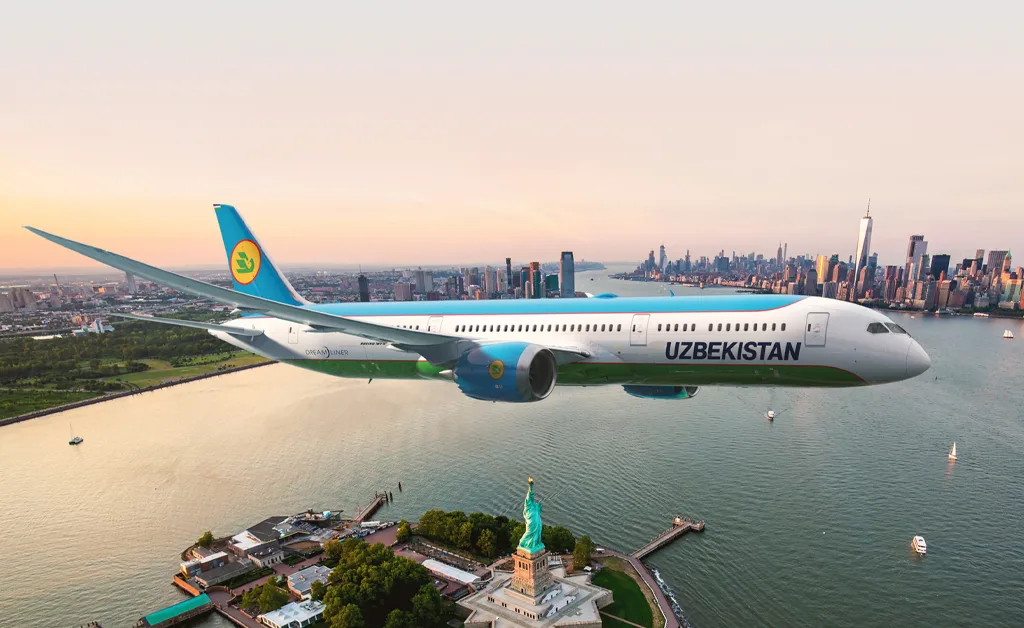
When the leaders of Central Asia gathered in Washington in November 2025 for the C5+1 Summit, one of the loudest headlines came not from a mine or a pipeline but from an aircraft factory. Boeing secured orders from three regional carriers, Air Astana of Kazakhstan, Uzbekistan Airways and Somon Air of Tajikistan, that together could be worth more than seven billion dollars at list prices, turning a diplomatic gathering into a showcase of American manufacturing.
Three Airlines, One Manufacturer
The combined deals covered up to 10 Boeing 737 MAX jets and 27 Boeing 787 Dreamliner widebody aircraft. Air Astana, Kazakhstan’s flag carrier, agreed to acquire up to 15 Dreamliners in the largest fleet expansion in its history. Uzbekistan Airways converted options into firm orders that lifted its total Dreamliner commitment to 22 aircraft, cementing Tashkent’s role as a regional aviation hub. Somon Air placed the first widebody order in its history, mixing Dreamliners with 737 MAX jets to enter intercontinental markets for the first time and connect Tajikistan to far more distant destinations.
Tens of Thousands of American Jobs
For Washington, the orders were as much about domestic industry as foreign policy. The US Department of Commerce and Boeing framed the transactions as a showcase of American exports, noting that the Uzbekistan Airways order alone supports close to 35,000 jobs in the United States. Boeing’s Dreamliner program is centered in North Charleston, South Carolina, where thousands of workers and nearly 200 suppliers build the widebody jet. Every large international order ripples through that network, from fabrication and final assembly to engines, avionics and long term maintenance and training contracts.
Opening New Routes to America
The aircraft are not just symbols. Uzbekistan Airways already flies its Dreamliners to markets in Europe, Asia and the United States, including a direct service to New York, and it plans to use the newer variant to expand American routes further. Air Astana intends to strengthen transcontinental connections, while Somon Air’s entry into long haul flying could eventually link Tajikistan directly to distant markets. More direct air links mean easier movement of business travelers, tourists and cargo, reinforcing the commercial ties that trade agreements are designed to build. Aviation deals also tend to deliver quick and visible results, since each aircraft represents a concrete export that shows up in trade figures almost immediately and keeps American production lines busy for years. Together the three carriers reflect the fast rising demand for air travel across a young and increasingly mobile region, and for governments on both sides that visibility makes aviation one of the most attractive arenas in the entire relationship.
From Announcement to Delivery
Not every commitment carries the same weight. The Uzbekistan Airways conversion was a firm order that immediately affects Boeing’s backlog and triggers financing and preparation, while some of the other announcements represent intent that still requires binding contracts. Engine selection, involving suppliers such as GE Aerospace and Rolls Royce, along with maintenance, training and route certification, must all follow before the jets enter service.
Even so, the scale of the C5+1 aviation package signals a clear shift. Central Asian carriers are modernizing rapidly, and they are increasingly turning to American manufacturers to do it, converting a diplomatic summit into billions of dollars of orders that will shape the region’s skies for years to come.
