
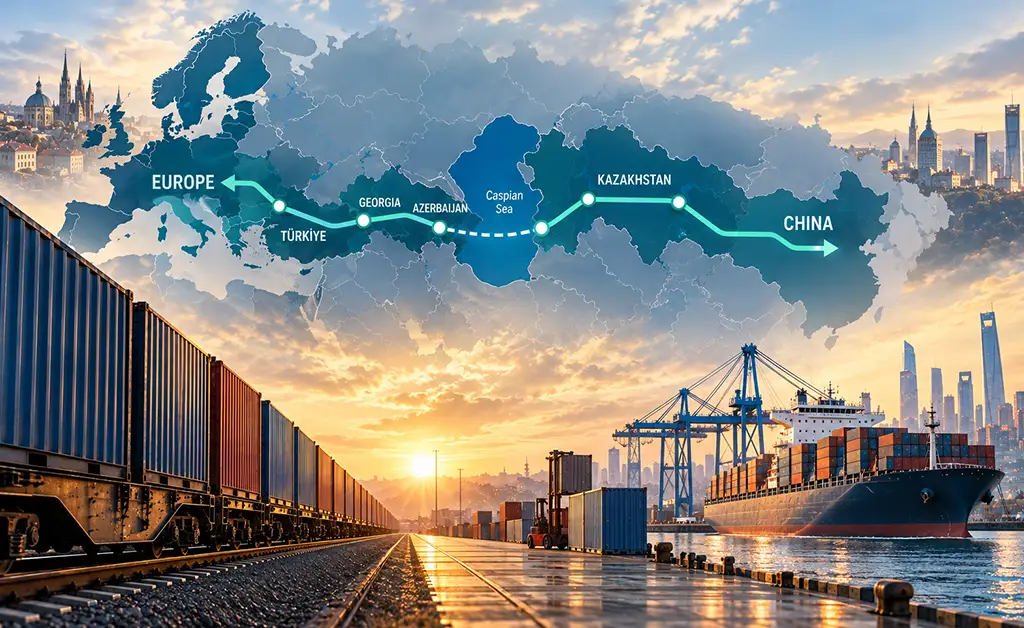
AZERBAIJAN — Operational figures covering the first eight months of 2026 demonstrate continued quantitative expansion along the Trans-Caspian International Transport Route, widely known as the Middle Corridor. Data released on 10 September 2026 indicates that freight traffic across the corridor reached 53,574 twenty-foot equivalent units between January and August, representing an 11 per cent increase compared to 48,326 units moved during the same period in 2025. A total of 265 container block trains were successfully dispatched across the multi-modal network during this timeframe.
Despite encouraging volume growth, detailed operational metrics highlight a severe structural imbalance in freight distribution. Westbound cargo moving from East Asia toward European markets accounted for 80 per cent of total corridor throughput, totaling 42,642 container units. In stark contrast, eastbound traffic moving from Europe toward Central Asia and China comprised only 20 per cent of total volume, amounting to just 10,932 units. This acute four-to-one operational asymmetry forces logistics operators to reposition thousands of empty containers back to eastern origin points at significant financial expense. Resolving the middle corridor eastbound cargo imbalance has consequently emerged as the primary operational imperative for corridor member states and commercial railway operators.Commercial Implications for Trans-Caspian Freight Rates
The severe directional imbalance directly impacts corridor profitability, asset utilization, and commercial pricing structures. Multi-modal transit across the Caspian Sea requires coordinated vessel sailings, port handling, and rail transfers across multiple national jurisdictions. When vessels and rail flatcars return eastward carrying empty containers, overall operating margins decline, placing upward pressure on westbound freight rates.
Logistics advisors at Azerbaijan Railways have emphasized that attracting consistent European export cargo is essential to optimize route economics and lower unit costs. Commercial breakthroughs demonstrate potential solutions. In May 2026, a specialized block train dispatched 50 forty-foot containers loaded with commercial refrigerators from Turkey directly to China, demonstrating that manufactured consumer goods and industrial machinery can effectively utilize eastbound return capacity. For European and American exporters shipping goods into Central Asia, empty container availability creates favorable bargaining leverage to negotiate competitive transport rates. Tracking fluctuations in trans caspian route container rates 2026 provides valuable commercial insight for international supply chain planners.World Bank Guarantees Fuel Infrastructure Expansion Target
Multilateral financial institutions are committing substantial capital resources to eliminate logistical bottlenecks and improve corridor efficiency. In February 2026, the World Bank mobilized an extensive 1.41 billion dollar railway investment framework, underpinned by 846 million dollars in financial guarantees. This capital deployment is structured to modernize track infrastructure, expand port handling capacity, and digitize customs procedures along key rail bottlenecks.
The strategic objective of these multilateral investments is to triple overall corridor freight capacity by 2030 while reducing total transit times by half. Physical infrastructure upgrades include expanding container terminal capacity at Baku International Sea Trade Port and Aktau Port, alongside track duplication projects along regional rail networks. Digital integration platforms are also being implemented to standardize electronic freight documentation across national borders, reducing delay times at sea-to-rail transfer points. Long-term growth projections depend entirely on whether these structural upgrades can support expanding middle corridor TEU volumes 2026 while simultaneously balancing directional trade flows.Regional Transit Realignment and Geopolitical Risk Factors
The evolution of the Middle Corridor takes place within a complex regional logistics landscape. Alternative transit routes across neighboring territories continue to emerge, introducing distinct regulatory and compliance considerations for global logistics providers. Between 11 and 13 September 2026, reports confirmed that the initial China-Iran block train carrying 55 containers departed Xinjiang on 7 September, routing through Kazakhstan, Uzbekistan, and Turkmenistan toward its Iranian destination.
Industry analysts note that alternative transit corridors passing through sanctioned jurisdictions present heightened compliance scrutiny for international freight forwarders and Western logistics firms. Consequently, the Middle Corridor remains the preferred sanctions-compliant trade route connecting East Asia with Eastern Europe. As corridor management entities work to attract European manufactured exports to balance westbound container flows, the route’s commercial viability and competitive positioning will depend on achieving operational equilibrium across both transit directions.
