
Key Takeaways
- Turkmenistan’s State Service of Maritime and River Transport met a regional delegation from US-based AECOM on October 29, 2026, to discuss the Trans-Caspian Trade Route in Central Asia (TCTR) project.
- AECOM presented TCTR as a 2026 to 2028 program covering transport and logistics infrastructure, interregional corridors and investment in transport, energy and IT.
- TCTR is funded by the US Department of State through its Partnership for Global Infrastructure (PGI) fund and covers Kazakhstan, Kyrgyzstan, Tajikistan, Turkmenistan and Uzbekistan, according to subcontractor PMCG.
- Projects at the Balkan Shipbuilding and Ship Repair Plant on the Caspian coast were also on the agenda.
US engineering expertise is moving closer to the Trans-Caspian Trade Route. On 29 October 2026, Turkmenistan’s State Service of Maritime and River Transport met a regional delegation from US-based AECOM to discuss the Trans-Caspian Trade Route in Central Asia (TCTR) project.
In This Article
AECOM, a US infrastructure consulting and engineering firm, presented its TCTR programme, which is scheduled to run from 2026 to 2028. The two sides discussed modernising transport and logistics infrastructure, developing interregional corridors and attracting investment into Central Asia’s transport, energy and IT sectors.
What Did Turkmenistan and AECOM Discuss?
According to the Turkmen side’s press release, the talks covered several practical areas:
Transport corridors: modernising logistics infrastructure and improving links between regional routes.
Shipbuilding: projects at the Balkan Shipbuilding and Ship Repair Plant on the Caspian coast.
The TCTR programme: AECOM’s work plan for 2026–2028.
Investment: bringing new capital into transport, energy and IT across Central Asia.
AECOM has also discussed cooperation with KTZ Express, the logistics arm of Kazakhstan’s national railway, on developing the Trans-Caspian route. That suggests the company sees the corridor as a regional system rather than a series of national projects.
What Is the TCTR Project?
The Trans-Caspian Trade Route in Central Asia (TCTR) project is a US government-funded technical program implemented by AECOM. According to PMCG, a subcontractor on the project, it is financed by the US Department of State through its Partnership for Global Infrastructure fund, runs from April 2026 to June 2028 and covers Kazakhstan, Kyrgyzstan, Tajikistan, Turkmenistan and Uzbekistan.
Its stated goals are to advance strategic transport and logistics infrastructure along the Trans-Caspian corridor, reduce barriers to investment and support regional integration.
Turkmenistan’s Bid to Become a Transit Hub
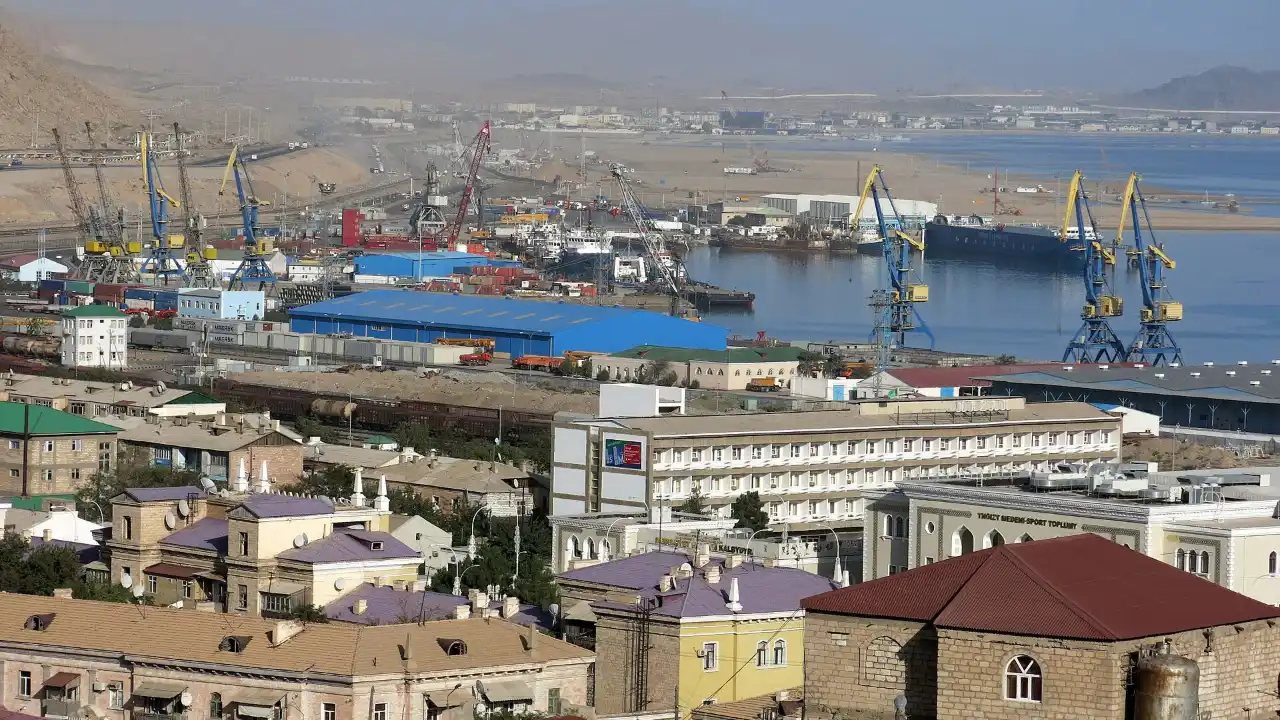
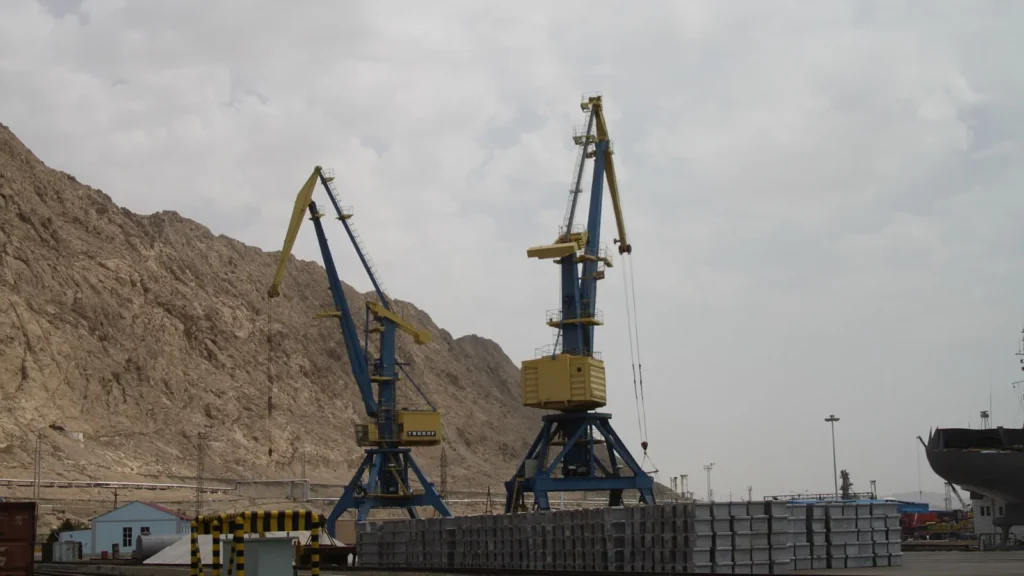
The meeting fits a wider strategy. Turkmenistan has modernised the Turkmenbashi International Seaport and is working towards a maritime single window system to simplify paperwork for shippers.
The port’s numbers show why that matters. A World Bank report found that utilisation at Turkmenbashi rose to 43% at the end of 2025, up from 19% in 2023. The port has an installed capacity of 17 million tonnes and 400,000 TEUs a year. Turkmen officials linked the 2025 growth to cargo on the China–Kyrgyzstan–Uzbekistan–Turkmenistan multimodal corridor and the China–Europe route.
In other words, there is still significant spare capacity. Filling it will depend on better rail connections, faster customs and more reliable shipping across the Caspian, which are exactly the areas engineering and consulting firms such as AECOM work on.
A Crowded Field of Partners
The United States is not the only partner showing interest. At the Turkmenistan Investment Forum 2026 in Ashgabat, EU Ambassador Luc Devigne said EU initiatives are aimed at developing the Trans-Caspian Transport Route, and described railway modernisation as an important step. The EU says trade along the corridor has quadrupled since 2022.
Earlier this year, Turkmenistan also launched a capacity development programme for the corridor running until 2029, implemented by GIZ and Expertise France with support from the EU, Germany and France. Its priorities include international standards, staff training and making Turkmenbashi a value-added hub on the modern Silk Road.
The AECOM programme and the European-backed programme appear to be separate initiatives. Together, however, they show how much international attention the Caspian crossing is now attracting.
Why the Trans-Caspian Trade Route Matters for US Business
The Trans-Caspian route, often called the Middle Corridor, links China and Central Asia with Europe via the Caspian Sea, the South Caucasus and Türkiye. It has become a priority in US policy towards the region, as seen at the recent C5+1 ministerial meeting in Samarkand.
For US companies, AECOM’s involvement is a useful signal. Engineering, design and project management contracts often come first, and equipment, technology and services orders follow. Rail, port equipment, digital customs systems and energy infrastructure all look like promising areas.
There are challenges too. As we have noted in our analysis of the Middle Corridor’s backhaul gap, traffic remains unbalanced, and large investment needs remain. Our guide to the World Bank’s $55 billion Trans-Caspian blueprint sets out where that money is expected to go.
Turkmenistan wants to be a regional transit hub, and American expertise is now part of that picture. ATBA will follow how the TCTR programme progresses and what opportunities it creates for US and Turkic businesses.
Cover image: Bohndorf Film-Team / Wikimedia Commons, CC BY-SA 4.0.
What This Means for Turkish American and Turkic Businesses
For US engineering, port equipment, rail and digital customs companies, TCTR is an early-stage opening: technical studies and project preparation under a State Department-funded program often shape later procurement. Firms should register interest with AECOM’s regional team and follow tenders at Turkmenbashi port and the Balkan shipyard.
Turkic diaspora logistics and freight-forwarding firms in the United States can use the program’s progress to plan Caspian routings through Turkmenistan as an alternative to Kazakhstan-Azerbaijan crossings. Checking current port capacity, schedules and customs procedures before committing cargo remains essential.
Frequently Asked Questions
Who funds the Trans-Caspian Trade Route (TCTR) project?
The TCTR project is funded by the US Department of State through its Partnership for Global Infrastructure fund and implemented by AECOM, according to PMCG, a subcontractor on the program. It runs from April 2026 to June 2028 across five Central Asian countries.
What did Turkmenistan and AECOM discuss on October 29, 2026?
According to Turkmenistan’s State Service of Maritime and River Transport, the sides discussed modernizing regional transport and logistics infrastructure, interregional corridors, projects at the Balkan Shipbuilding and Ship Repair Plant, and attracting investment into transport, energy and IT in Central Asia.
Is AECOM working with other countries on the Trans-Caspian route?
Yes. Trend News Agency reported that AECOM has also discussed cooperation with KTZ Express, the logistics arm of Kazakhstan’s national railway, on developing the Trans-Caspian route. TCTR itself covers Kazakhstan, Kyrgyzstan, Tajikistan, Turkmenistan and Uzbekistan.
Sources
- Trend News Agency, Turkmenistan, U.S.-Based AECOM Discuss Modernization of Transport Corridors, October 30, 2026. Accessed November 16, 2026.
- PMCG, PMCG Begins Implementation of the Trans-Caspian Trade Route (TCTR) Project, June 16, 2026. Accessed November 16, 2026.
Related Coverage
- C5+1 Bets on the Middle Corridor and Critical Minerals in Samarkand
- The Small-Market Opening: Kyrgyzstan’s EXIM-Backed Wabtec Order and Turkmenistan’s Investment Slowdown
- Azerbaijan as a Regional Base: The $201 Million Trans-Caspian Fund and What the USACC Playbook Signals
About the American-Turkic Republics Business Alliance (ATBA)
The American-Turkic Republics Business Alliance (ATBA) is a New York-based nonprofit platform that strengthens trade, investment and business collaboration between the United States and the Turkic republics: Türkiye, Azerbaijan, Kazakhstan, Uzbekistan, Kyrgyzstan and Turkmenistan. Companies and professionals can join the network through ATBA membership.
