
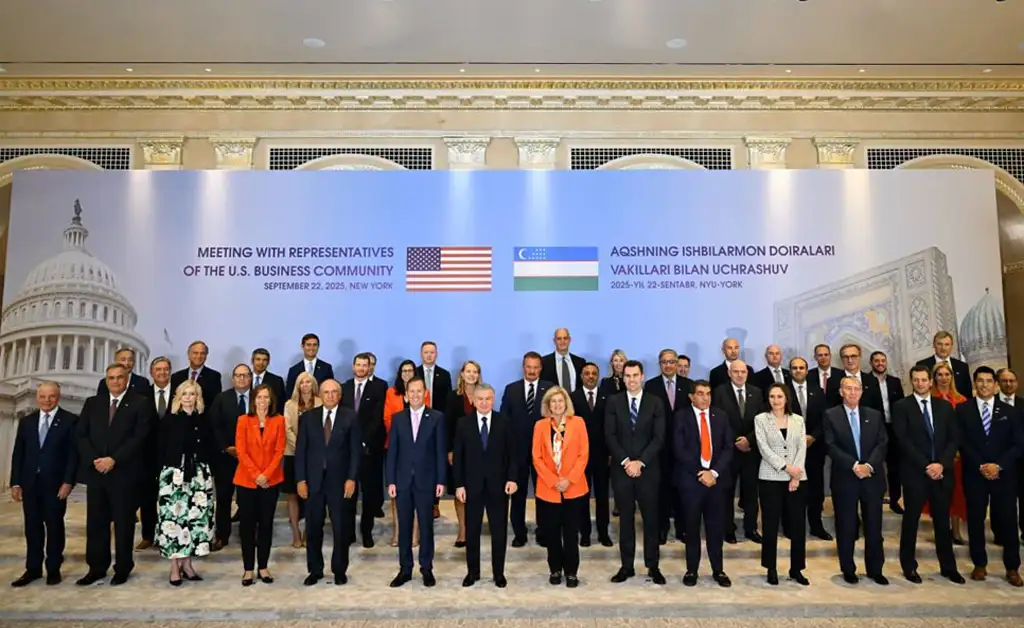
The United States and Uzbekistan are accelerating work towards a broader reciprocal trade and investment framework as both sides seek to turn rapidly developing commercial ties into a more structured economic relationship.
The two countries announced a package of trade commitments on 25 June 2026, including Uzbekistan’s decision to eliminate or reduce tariffs on a wide range of U.S. industrial and agricultural goods. At the same time, Washington and Tashkent agreed to speed up negotiations on an Agreement on Reciprocal Trade and Investment.
The move could become an important milestone for businesses on both sides because it addresses not only tariffs, but the wider environment for trade and investment.
Trade Becomes a Central Economic Priority
The proposed framework comes at a time when bilateral goods trade has crossed the $1 billion threshold. U.S. goods trade with Uzbekistan exceeded $1 billion in 2025, with American exports rising 24.5% to $473.9 million and U.S. imports from Uzbekistan reaching $574.4 million.
Those figures indicate that the relationship is still relatively small compared with the scale of the two economies, but the growth rate suggests significant room for expansion.
A reciprocal agreement could provide a more predictable framework for companies considering longer-term commercial activity.
Tariff Reductions Open the Door
The initial trade package includes an “early harvest” of tariff commitments from Uzbekistan. The country will eliminate or reduce tariffs on a broad range of American industrial and agricultural products.
The United States offered favourable consideration for Uzbek products in future tariff actions where U.S. law allows, although the announcement does not guarantee automatic tariff reductions.
For American exporters, lower Uzbek duties could improve the competitiveness of machinery, equipment, agricultural products and other goods. For Uzbekistan, increased access to U.S. products could support modernisation and competition across domestic industries.
Investment Is Being Built Into the Relationship
The trade discussions are taking place alongside new investment mechanisms. A U.S.-Uzbekistan Business and Investment Council began work in April, while a joint investment platform was launched in June.
The platform focuses on areas including energy, infrastructure, critical minerals and manufacturing.
This matters because Uzbekistan is seeking to attract more than conventional portfolio capital. The country wants industrial projects, technology, production capacity and long-term partnerships.
A U.S. business forum in Tashkent brought together representatives from 193 American companies, demonstrating the scale of commercial interest.
Critical Minerals and Manufacturing Add Strategic Depth
Critical minerals are an increasingly important part of the economic relationship. Uzbekistan is seeking to develop its mineral resources while increasing domestic processing and industrial capacity.
For American companies, that can create opportunities in exploration, mining technology, processing, equipment and supply chains.
Manufacturing is another area where the relationship could deepen. Uzbekistan’s expanding domestic market and growing industrial base provide a potential platform for companies seeking a Central Asian production or distribution presence.
Why the Agreement Matters to Businesses
Trade agreements matter because companies make investment decisions based on predictability. Tariffs are only one part of the equation. Businesses also consider market access, investment rules, supply chains, regulation and the ability to repatriate capital.
A broader reciprocal trade and investment agreement could therefore provide greater clarity if negotiations ultimately produce detailed and enforceable commitments.
The process is still underway, so the final scope should not be assumed. The current announcements establish a direction rather than a completed agreement.
A Relationship Moving Towards Commercial Scale
The latest developments suggest that U.S.-Uzbekistan economic relations are moving from individual projects towards a broader commercial architecture.
Tariff reductions can increase trade in the short term, while a reciprocal investment framework could support longer-term capital flows. New investment institutions can then help convert interest into specific projects.
For Uzbekistan, the strategy fits a broader economic opening and reform agenda. For the United States, it creates opportunities in a large and rapidly developing Central Asian market.
The next phase will depend on negotiations and implementation. If the two sides successfully translate the current commitments into a comprehensive framework, the result could be a more predictable and significantly larger platform for U.S.-Uzbekistan trade and investment.
