
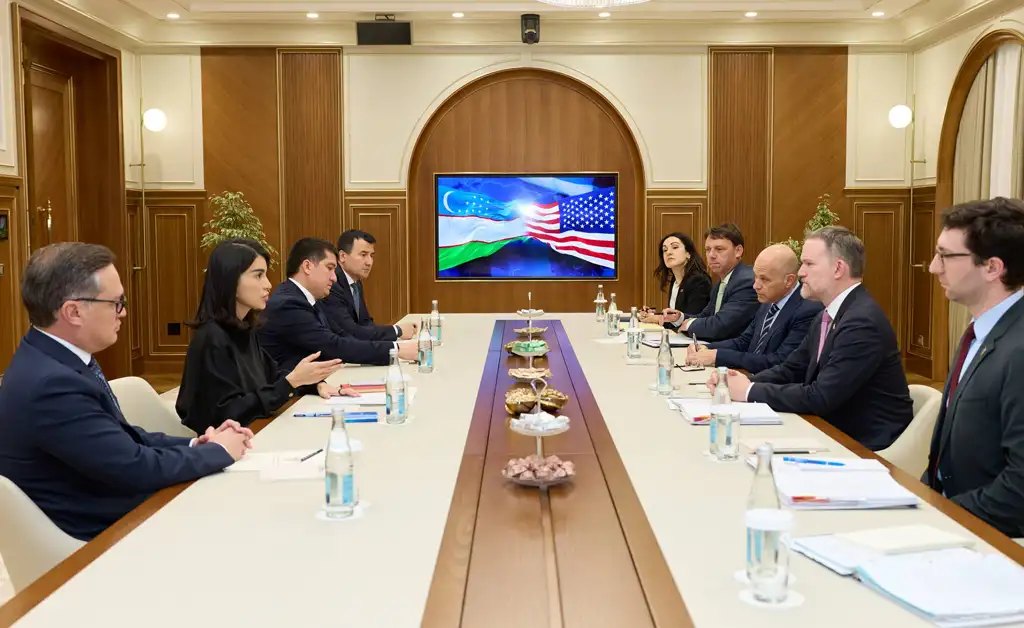
Uzbekistan and the United States have moved to deepen their commercial relationship with a new package of trade commitments that places tariff reductions, market access and investment at the centre of the bilateral economic agenda.
Announced on 25 June 2026, the package includes Uzbekistan’s commitment to eliminate or reduce tariffs on a wide range of U.S. industrial and agricultural goods. The two governments also agreed to accelerate negotiations on an Agreement on Reciprocal Trade and Investment, signalling an effort to build a broader commercial framework rather than relying only on individual transactions.
The development gives U.S. exporters a clearer route into one of Central Asia’s fastest-growing consumer and industrial markets. For Uzbekistan, the measures offer a way to increase access to American technology, machinery, agricultural products and other goods while encouraging additional investment.
Tariff Changes Put Market Access in Focus
Under the announced “early harvest”, Uzbekistan will eliminate or lower tariffs on a broad group of U.S. industrial and agricultural products. Washington, meanwhile, indicated that Uzbek products would receive favourable consideration in future U.S. tariff actions where U.S. law permits, although the announcement does not guarantee automatic reductions for Uzbek exports.
The commitments are expected to be formalised in the coming weeks. Their importance lies partly in the fact that they address a practical barrier to trade: the cost of entering each other’s markets.
U.S. Trade With Uzbekistan Has Passed the $1 Billion Mark
The agreement comes as bilateral goods trade is expanding from a relatively modest base. U.S. goods trade with Uzbekistan exceeded $1 billion in 2025. American exports to Uzbekistan rose 24.5% to $473.9 million, while U.S. imports from Uzbekistan reached $574.4 million.
The figures show that the commercial relationship is still developing, but they also provide room for substantial growth. Lower tariffs could make American equipment and products more competitive in Uzbekistan while supporting Uzbek exporters seeking greater access to the U.S. market.
Investment Channels Are Expanding Alongside Trade
The tariff package is part of a wider push to build investment links. A U.S.-Uzbekistan Business and Investment Council began work in April, followed in June by the launch of a joint investment platform. Priority areas include energy, infrastructure, critical minerals and manufacturing.
A business forum in Tashkent also attracted representatives from 193 U.S. companies, underlining the growing interest of American businesses in Uzbekistan’s expanding economy.
The focus on critical minerals is particularly significant. Uzbekistan is seeking to develop more domestic processing capacity and attract capital and technology into strategic industries. For U.S. companies, that creates potential opportunities beyond conventional exports, including industrial partnerships and supply-chain projects.
Why the Trade Framework Matters
The proposed reciprocal trade and investment agreement could become an important next step if negotiations produce a comprehensive framework. Such an agreement could help establish clearer rules for companies considering longer-term projects, while potentially widening cooperation beyond goods trade.
For Uzbekistan, improved access to American products and capital fits with its broader economic reform programme. For the United States, the country represents a growing Central Asian market with demand for industrial equipment, technology, infrastructure services and agricultural products.
The economic relationship is therefore moving towards a more practical phase. Rather than being defined primarily by diplomatic engagement, the latest measures put tariffs, market access, investment and commercial projects at the forefront.
A Broader Commercial Relationship Ahead
The immediate impact will depend on how quickly the tariff commitments are implemented and how negotiations on the reciprocal trade and investment agreement progress. Businesses will also be watching which products receive lower duties and whether the changes translate into increased trade volumes.
Still, the direction is clear. Uzbekistan is opening additional channels for American goods and investment while seeking stronger access to the U.S. market. If the commitments are implemented as announced, the latest package could become an important foundation for a larger U.S.-Uzbekistan trade relationship in Central Asia.
